
The lamplight flickers behind lace curtains on Jefferson Avenue, casting trembling shadows across the porch of a Victorian home that has stood watch over this quiet Columbus street for more than a century. The neighborhood settles into evening silence. A car passes. A dog barks somewhere distant. And inside the darkened windows of the Thurber House, something stirs.
This elegant residence once sheltered one of America’s most beloved humorists, James Thurber, whose whimsical cartoons and razor-sharp prose defined a generation of literary wit. Visitors come here expecting to walk through the pages of his celebrated essays, to breathe the same air that inspired decades of laughter.
What they often find instead is something far more unsettling.
The Thurber House has earned a darker distinction over the years, one that Thurber himself helped establish with his own accounts of spectral disturbances. Staff members exchange knowing glances when asked about the sounds that echo through empty hallways after closing. Writers who stay overnight speak in hushed tones about what they experienced in the small hours before dawn.
In a home celebrated for wit and whimsy, something decidedly less amusing has taken up permanent residence.
Ready For More Ghost Hunts?
Check Out Our Ghost Tours of ColumbusHistorical Background
Origins of the House
The house rose from Columbus soil in 1873, its Victorian bones taking shape during an era when the city was rapidly expanding beyond its frontier origins. Craftsmen laid each brick with care, fitted each window frame with precision, never knowing they were constructing what would become one of Ohio’s most persistently haunted addresses.
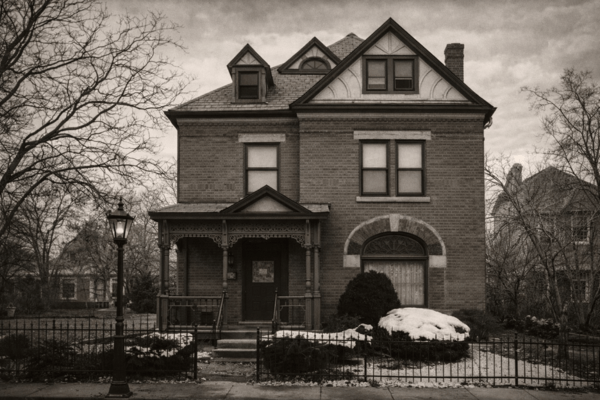
Situated in the historic Jefferson Avenue district, the residence embodied the aspirations of post-Civil War America. Its tall windows and ornate trim spoke of prosperity and permanence. Families would come and go through its doors over the following decades, each leaving behind traces of their lives within its walls.
Perhaps some left behind more than traces.
The Thurber Family Years
In 1913, a young James Thurber moved into the house with his family while attending Ohio State University. He was not yet the literary giant he would become, just a college student with sharp eyes and an even sharper pen. The home on Jefferson Avenue would shelter him until 1917, years that would prove formative in ways he could not have anticipated.
It was here that Thurber experienced something that would haunt his memory long after he left Columbus behind.
His famous 1933 essay, “The Night the Ghost Got In,” recounts a harrowing evening of unexplained footsteps, doors slamming of their own accord, and a household thrown into complete panic. Thurber wrote of sounds circling the dining room table, ascending the stairs, moving through the house with deliberate purpose while the family huddled in confusion and fear.
He told the story with his characteristic humor. But beneath the comedic surface, something genuinely disturbing had occurred in this house. Something Thurber never fully explained away.
Later History and Preservation
After the Thurber family departed, the house passed through various hands and served numerous purposes. Time wore at its Victorian grandeur. Paint peeled. Floorboards groaned with age. The structure seemed destined for demolition or decay.
But the literary legacy proved too powerful to abandon.
Preservationists rallied to save the home, eventually transforming it into a literary center, museum, and writer-in-residence program that continues to this day. As restoration crews worked to return the house to its former elegance, something else seemed to awaken within its walls.
The more life returned to the Thurber House, the more the dead made their presence known.
Reported Hauntings
The Ghost Thurber Wrote About
Thurber’s 1933 essay remains the foundational text of the house’s haunted reputation. He described footsteps pounding up the stairs at breakneck speed, doors crashing shut with violent force, and an entire family driven to near hysteria by sounds they could not explain.
The question that has lingered for nearly a century is simple: was Thurber telling the truth?
Some scholars dismiss the account as pure literary embellishment, the product of a humorist mining his own life for comedy. Others point to the specific details, the genuine terror that bleeds through even his most amusing passages, and wonder if Thurber witnessed something real that night on Jefferson Avenue.
The fact that similar phenomena continue to plague the house suggests Thurber may have been more reporter than inventor.
The Lady in White
She appears without warning and vanishes just as quickly. A woman in pale clothing, drifting through hallways with the silence of smoke. Witnesses have spotted her near the main staircase, gliding past doorways, pausing at windows as if watching the street below.
Her identity remains unknown.
Some speculate she was a former resident, perhaps someone who died within these walls during the house’s long history. Others suggest a connection to some forgotten tragedy, a story lost to time but not to the house itself. She never speaks. She never acknowledges the living. She simply moves through spaces that once belonged to her, repeating patterns established long ago.
Those who have seen her describe an overwhelming sense of sadness that lingers long after she fades from view.
Unexplained Phenomena
The Lady in White is far from the only disturbance troubling the Thurber House.
Staff members have grown accustomed to objects that refuse to stay where they are placed. Books shift positions overnight. Papers scatter across desks that were left perfectly organized. Small items vanish entirely, only to reappear in impossible locations days or weeks later.
Cold spots materialize without explanation, pockets of frigid air that seem to follow visitors through rooms. The sensation of being watched has become so common that longtime employees barely mention it anymore. It is simply part of working at the Thurber House.
Most unsettling are the footsteps.
They echo through empty rooms after the last visitor has gone. They climb staircases when every door is locked. They pace hallways in the dead of night, deliberate and unhurried, as if whoever is walking has nowhere else to be and all of eternity to get there.
Electrical systems behave erratically. Lights flicker and fail. Bulbs burn out at impossible rates. Switches flip themselves on and off while witnesses stand frozen in disbelief.
The Presence in the Attic
The upper floors of the Thurber House carry a weight that visitors notice immediately. The air grows heavier with each step toward the attic. Breathing becomes more labored. The sense of intrusion intensifies.
Something waits up there.
Those who venture to the highest reaches of the house report an oppressive presence, a feeling of being scrutinized by unseen eyes. Some describe it as distinctly male, a watchful entity that does not appreciate visitors in its domain. Shadow figures have been glimpsed in peripheral vision, dark shapes that dissolve when confronted directly.
Writers participating in the residence program have emerged from nights on the upper floors visibly shaken, unwilling to discuss what they experienced but equally unwilling to return.
Haunted Hotspots Within the Location
The Staircase
The main staircase stands at the heart of the Thurber House haunting. This was the pathway the phantom footsteps traveled in Thurber’s original account, ascending from the dining room with terrible speed while the family listened in horror from above.
Nearly a century later, those footsteps continue.
Visitors and staff alike have heard someone climbing and descending these stairs when every room stands empty. The sounds are unmistakable: the creak of old wood, the rhythm of deliberate steps, the pause at landings. Turn toward the noise and find nothing but still air and silent treads.
The Third Floor and Attic
Writers who stay overnight as part of the residence program often request rooms on the lower floors. Those who accept accommodations on the third floor or near the attic rarely make the same choice twice.
Temperature drops come without warning, sudden plunges that turn warm rooms into freezing chambers within seconds. Shadow figures drift at the edges of vision. The sensation of another presence becomes impossible to ignore, a certainty that someone stands just out of sight, watching, waiting.
Sleep comes difficult in these upper reaches. When it comes at all.
Thurber’s Bedroom
The room where young James Thurber once slept retains a peculiar energy that sensitive visitors notice immediately. Some describe it as watchfulness, as if the room itself is paying attention. Others report a lingering presence, neither threatening nor welcoming, simply there.
Whether this energy connects to Thurber himself or to some earlier occupant remains unclear. What is certain is that this bedroom affects people in ways the other rooms do not. Visitors emerge quiet and contemplative, as if they have just concluded a conversation they cannot quite remember.
The Basement
Below the living quarters, beneath the foundation stones, the basement holds its own secrets. Staff members rarely discuss what happens down there, but rumors persist of residual energy, of sounds emanating from the depths that have no earthly source.
Scraping noises. Whispered voices. The sense that something very old lurks in the darkness beneath the house.
Most visitors never see the basement. Perhaps that is for the best.
Visiting the Site Today
Public Access
The Thurber House welcomes visitors as a fully operating museum and literary center. Guided tours lead guests through rooms where history and haunting intertwine, offering glimpses into both Thurber’s creative life and the supernatural occurrences that have made the house infamous.
Occasional ghost-themed events draw crowds eager to experience the darker side of this literary landmark. These special programs often extend into evening hours, when the house reveals its true character.
Writer-in-Residence Program
For those seeking deeper immersion, the writer-in-residence program offers overnight stays within the house itself. Authors come hoping to find inspiration in Thurber’s former home. Many leave with stories they never intended to write.
The accounts these writers share form an ongoing catalog of the unexplained. Footsteps in empty hallways. Doors that open on their own. The unmistakable sensation of sharing space with something unseen.
Tips for Visitors
Evening visits capture the Victorian atmosphere at its most potent, when shadows lengthen and lamplight flickers against aged wallpaper. The house transforms after dark, revealing aspects that daylight hours conceal.
Respect for the literary and historical significance of the space should guide every visit. This remains a working cultural center, a place where Thurber’s legacy continues to inspire new generations of writers.
Staff members often prove willing to share their own encounters when asked. Their stories add layers to the experience that no guidebook can provide.
Best Times to Visit
Autumn evenings offer the ideal atmospheric conditions for experiencing the Thurber House. Falling leaves drift past windows. Early darkness wraps the Victorian structure in shadow. The season itself seems to amplify whatever energies dwell within.
October events specifically highlight the home’s haunted reputation, drawing visitors who wish to confront the supernatural alongside fellow seekers. These gatherings honor both Thurber’s literary achievements and the restless spirits who share his former residence.
Closing Scene
The last visitor steps through the front door as evening settles over Jefferson Avenue. Behind them, locks click into place. The house falls silent, or what passes for silence in a building where the dead refuse to rest.
A neighbor walking her dog glances up at the old Victorian and pauses. There, in an upper window, lamplight glows warm against the glass. A shape moves behind the curtain, just for a moment, then stillness returns.
No one should be inside. The staff left an hour ago. The doors are locked, the alarm set, every room confirmed empty.
And yet.
In the Thurber House, the stories never stop being written. The pens may have grown cold, the hands that held them long since turned to dust. But somewhere in those shadowed rooms, on those creaking stairs, in the heavy silence of the attic, the authors continue their work. They write with footsteps and flickering lights, with cold breath on the back of the neck and figures glimpsed in darkened doorways.
They write, and the living read their words whether they wish to or not.