
When night descends upon downtown Fort Worth, the Tarrant County Courthouse transforms into something far more imposing than a mere government building. Its massive pink granite walls absorb the glow of streetlights, casting the Renaissance Revival towers into sharp relief against the Texas sky. The structure rises like a monument carved from some ancient, fossilized dream of order and punishment.
Standing sentinel over this corner of Fort Worth since 1895, the courthouse has witnessed more than a century of human drama at its most desperate. Verdicts have echoed through these corridors. Sentences have been pronounced. Lives have ended, both literally and figuratively, within these walls.
But not everyone who entered the Tarrant County Courthouse ever truly left. Some say the building holds onto its dead the way old stone holds onto cold. A monument to frontier justice, certainly. A repository of restless souls who never found their way out. That much is harder to dismiss when standing in the courthouse’s shadow after dark.
Ready For More Ghost Hunts?
Check Out Our Ghost Tours of Fort WorthHistorical Background
Construction and Architectural Significance
The courthouse that stands today rose from the dust of a rapidly evolving frontier town. In 1895, architects Gunn and Curtis completed their masterwork, a building that would come to define the visual identity of Tarrant County for generations. The pink granite exterior, quarried from the hills of Central Texas, gave the structure a warmth that belied the cold calculations of justice conducted within.
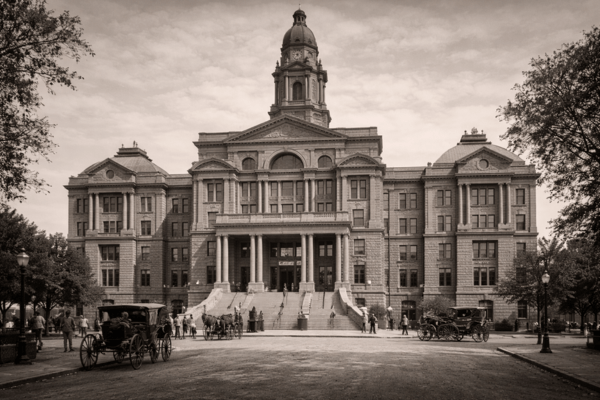
The design represents one of the finest examples of Texas Renaissance Revival architecture in the entire state. Ornate towers reach toward the heavens as if appealing to a higher court. Arched windows peer out like watchful eyes. Every cornice and column speaks to an era when civic buildings were constructed not merely to function but to intimidate, to inspire, to remind citizens of the awesome power of law.
Fort Worth in those days was still shaking off its reputation as a rough cattle town, a place where disputes were settled as often with fists and firearms as with legal proceedings. The courthouse was meant to represent civilization’s triumph over chaos. Whether it succeeded in that mission is a matter of perspective. Whether it absorbed something of the chaos it sought to contain is another question entirely.
Dark History of Frontier Justice
The weight of what transpired within these walls cannot be measured in pounds of granite or years of service. Countless criminal trials unfolded in the upper floor courtrooms, each one a collision between accusation and defense, between the state’s cold machinery and the desperate hopes of the accused. Death sentences were pronounced here with a frequency that modern sensibilities struggle to comprehend.
Men walked into these halls knowing they might never walk out free again. Some were guilty beyond question. Others maintained their innocence until the moment the noose tightened. The condemned left behind more than just their mortal remains. They left the reverberations of their final words, their last desperate pleas, the echoes of verdicts that sealed their fates forever.
Grieving families filled the gallery benches, watching as fathers, sons, and husbands were led away in chains. Widows collapsed in corridors. Mothers wailed in the marble halls. The emotional residue of such concentrated human suffering does not simply evaporate with the passing of decades.
The courthouse also bears the legacy of the Texas Rangers and the violent conflicts that defined the Old West. Outlaws, cattle rustlers, and killers all faced judgment here. The building became a crucible where the lawless met the law, and where the outcome was often written in blood before it was written in legal documents.
Reported Hauntings
The Specter of the Condemned
Those who work late in the Tarrant County Courthouse have learned not to trust their peripheral vision. Shadowy figures appear at the edges of sight, only to dissolve when confronted directly. These apparitions are most frequently spotted near the former holding areas, locations where the condemned spent their final hours before being led to judgment.
Witnesses describe the figures as distinctly out of time. Their clothing belongs to another century. Wide-brimmed hats, worn boots, rough cotton shirts. These are not the ghosts of modern defendants. They are the restless remnants of frontier justice, men who received death sentences within these courtroom walls and who have never accepted that their time is truly over.
Some employees refuse to work alone in certain sections of the building. The feeling of being observed is too intense, they say. The sensation of standing in the presence of something profoundly wronged is too difficult to ignore.
The Woman in White
She appears without warning and vanishes without explanation. The Woman in White has been glimpsed drifting through the courthouse corridors for decades, a spectral female figure whose identity remains one of the building’s most persistent mysteries.
Descriptions vary in detail but agree on the essentials. She wears a long white dress, possibly a mourning gown from the Victorian era. Her face is difficult to discern, sometimes appearing as a pale blur, other times as an expression frozen in grief. She moves with purpose through the halls, as if searching for something or someone she can never find.
Theories about her identity swirl through local legend. Some believe she was the widow of a man wrongfully executed, returning eternally to the site of the injustice that destroyed her life. Others connect her to a tragic case from the courthouse’s early years, perhaps a woman driven to madness by a verdict that tore her family apart. Whatever the truth, she continues her solitary patrol of the corridors, indifferent to the living who cross her path.
Disembodied Voices and Phantom Footsteps
The auditory phenomena reported within the courthouse may be the most unsettling of all. Empty rooms fill suddenly with the sounds of heated arguments, voices raised in anger or desperation, as if long concluded trials were being conducted again in some dimension just beyond human perception.
Staff members have reported hearing sobbing emanating from vacant offices. The weeping sounds distinctly feminine, raw with grief, as if fresh tragedy had just occurred rather than something a century old. When investigators approach the source, the sound ceases abruptly, leaving only oppressive silence.
Whispered conversations float through the air in places where no one is present. The words are indistinct, just beyond comprehension, but the tone is unmistakable. Urgency. Fear. Pleading.
Perhaps most common are the phantom footsteps. Heavy boots striking marble floors, approaching from distant corridors, growing louder and closer. Security guards have investigated these sounds countless times, only to find empty hallways stretching into darkness. The footsteps simply stop, as if whoever made them stepped through a door that exists only for the dead.
Haunted Hotspots Within the Location
The Upper Floor Courtrooms
The original courtrooms occupy the upper floors of the courthouse, preserved with much of their historic character intact. Here, where life and death verdicts were delivered with grim regularity, the atmosphere remains thick with something that defies rational explanation.
Visitors report sudden drops in temperature, cold spots that materialize without any draft or logical source. The chill seems to settle into bone, a penetrating cold that carries with it a sense of intense dread. Those who linger in these spaces describe feeling judged, as if unseen eyes were weighing their souls from every corner of the room.
The judge’s bench, the witness stand, the defendant’s chair. Each position seems to hold its own particular energy, its own residue of the countless human dramas that unfolded here. Some visitors find themselves unable to remain in these courtrooms for more than a few minutes. The weight of accumulated suffering becomes too heavy to bear.
The Basement and Lower Levels
Below the public floors, the basement and lower levels of the courthouse harbor their own particular darkness. Former holding cells once confined prisoners awaiting trial or sentencing. Restricted areas saw activities that never made it into official records. The air down here feels different, heavier, charged with something oppressive and trapped.
Those who have accessed these lower regions describe a claustrophobic energy that presses inward from every direction. The sensation of being watched intensifies dramatically. Shadows seem to shift in ways that lighting alone cannot explain. Some investigators believe that whatever energy was generated by fear, desperation, and hopelessness over the decades has become concentrated in these subterranean spaces, unable to escape, endlessly circulating.
Few people spend more time in the basement than absolutely necessary. Even those who dismiss supernatural explanations admit that something about the lower levels feels profoundly wrong.
The Grand Staircase
The grand staircase serves as the architectural heart of the courthouse, a sweeping expanse of marble and ironwork connecting the building’s various levels. It is also one of the most active locations for paranormal sightings.
Apparitions have been glimpsed ascending or descending the stairs at odd hours. They move with deliberate purpose, climbing toward the courtrooms or descending toward the exits, before simply vanishing mid-step. Witnesses describe the figures as semi-transparent, there and then suddenly not there, as if the building briefly revealed a layer of itself that normally remains hidden.
Even when no apparitions are visible, the staircase generates reports of paranormal sensation. The feeling of being watched. The conviction that someone is following just a few steps behind. The inexplicable urge to look over one’s shoulder, only to find nothing but empty air and the echo of footsteps that might or might not be one’s own.
Visiting the Site Today
The Tarrant County Courthouse remains an active government building, conducting legal business in the heart of downtown Fort Worth. Public access is permitted during business hours, though visitors should remain mindful that this is a functioning courthouse where real proceedings continue to unfold. Silence and respect are expected within its walls, both for the living and for whatever else might occupy these spaces.
Those seeking the most atmospheric experience should arrive at dusk, when the day’s business concludes and shadows begin their slow stretch across the granite facade. The transition from afternoon light to evening darkness transforms the building’s character entirely. What appears imposing by day becomes something far more unsettling as night approaches.
Exterior night photography offers exceptional opportunities for capturing the courthouse in its most evocative state. The towers reach toward the darkened sky. The arched windows catch reflections of streetlights. The pink granite takes on deeper, more ominous tones. Those with patience and a quality camera may find themselves capturing more than they expected.
Closing Scene
The courthouse empties as closing time arrives. Footsteps fade down corridors. Conversations trail off into silence. One by one, lights flicker off in offices and courtrooms, the building settling into its nightly vigil. Then, somewhere deep inside, a door slams shut with a force that echoes through the marble halls. No one is there to close it. No one living, at least.
In a place where so many fates were sealed, where verdicts of life and death were pronounced with the cold finality of hammered gavels, perhaps some souls still linger in the spaces between stone and shadow. They wait in the courtrooms where their futures were erased. They pace the holding cells where hope died. They drift through corridors that have become their eternal prison, waiting for a verdict that will never come, a pardon that will never arrive, an absolution that exists only in dimensions the living cannot reach.