
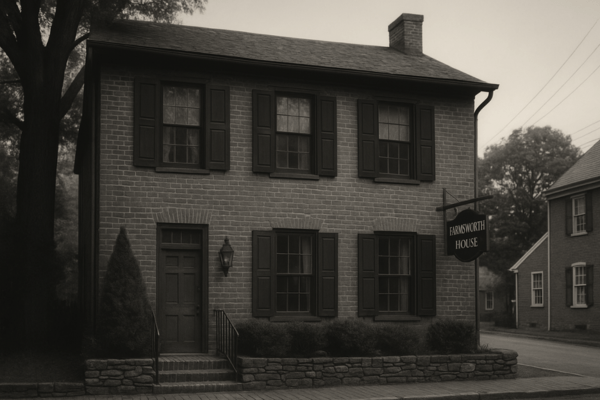
Picture this: a red-brick façade glowing softly under lantern light, ivy creeping up weathered walls, and the faint echo of boots on cobblestone drifting through the Pennsylvania night. This is the Farnsworth House Inn, standing tall on Baltimore Street in the heart of Gettysburg, where history and the supernatural walk hand in hand.
By day, the inn welcomes guests with the warm charm of a 19th-century retreat. Antique furnishings fill cozy rooms, the scent of home-cooked meals wafts from the tavern, and Civil War memorabilia adorns every corner. But when darkness falls, something shifts. Footsteps echo from empty hallways. Shadows drift past doorways. Whispers float through rooms where no one stands.
The Farnsworth House Inn is more than just one of Gettysburg’s most beloved historic landmarks. It’s one of the most haunted buildings in America, where the restless spirits of the Civil War refuse to leave their post.
A House Built Before the War
Long before bullets tore through its walls, the Farnsworth House stood as a peaceful private residence. Built in 1810, the sturdy brick home served as a quiet dwelling for local families, far removed from the violence that would one day consume the town.
The architecture reflects the simple elegance of early 19th-century craftsmanship. Thick brick walls, tall windows with original glass panes, and narrow hallways that wind through the structure like secret passages. The home’s layout speaks to a bygone era when families gathered around fireplaces and life moved at a slower, gentler pace.
For over five decades, the house witnessed ordinary moments: children playing in the yard, meals shared around wooden tables, seasons changing outside its windows. No one could have imagined that in July 1863, this peaceful home would become a sniper’s nest, a makeshift hospital, and a witness to one of the bloodiest battles in American history.
Ready For More Ghost Hunts?
Check Out Our Ghost Tours of GettysburgA Sniper’s Nest and a House Under Siege
Confederate Sharpshooters on the Upper Floor
When the Battle of Gettysburg erupted on July 1, 1863, Confederate forces quickly recognized the strategic advantage of the Farnsworth House’s elevated position. Soldiers climbed to the upper floors and attic, rifles in hand, and transformed the peaceful residence into a deadly observation post.
From the windows and garret, sharpshooters had clear views of Union positions across town. For three brutal days, the crack of rifle fire echoed from the building as marksmen picked off enemy soldiers with chilling precision.
The evidence remains visible today. Over 100 bullet holes still pock the brick exterior, frozen scars from the fury of battle. Each hole tells a story of near misses, desperate firefights, and the chaos that engulfed Gettysburg’s streets.
Death From Above
Among the many shots fired from the Farnsworth House, one holds particular tragedy. Historians believe a Confederate sharpshooter positioned in the building fired the shot that killed 20-year-old Mary Virginia “Jennie” Wade, the only civilian to die during the Battle of Gettysburg.
Jennie was baking bread in her sister’s kitchen on Baltimore Street when a Minié ball pierced through two wooden doors and struck her in the back. She died instantly, a young woman caught in the crossfire of a war that showed no mercy.
The connection between the Farnsworth House and Jennie’s death has left an emotional imprint that many believe still lingers. Some say the weight of that single, fatal shot changed the building’s energy forever, binding it to the tragedy of that July morning.
The Home as a Makeshift Hospital
As the battle raged, the Farnsworth House served another grim purpose. Wounded soldiers, both Confederate and Union, were carried inside for emergency treatment. The home’s rooms became operating theaters where surgeons worked by candlelight, amputating limbs and treating gunshot wounds with limited supplies.
Blood soaked into the wooden floorboards. Men screamed in agony. Some survived; many did not. Their suffering seeped into the very foundations of the building.
Even today, dark stains remain beneath some of the floors. Tours guide visitors to spots where bloodstains have resisted every attempt at removal, as if the house refuses to forget what happened within its walls.
The Hauntings of the Farnsworth House Inn
The Soldier in the Attic
Guests staying on the inn’s upper floors frequently report the same unsettling sounds: heavy footsteps pacing overhead, the distinctive clunk of military boots on wooden planks, and dragging noises that suggest someone moving with great effort.
The sounds always come from the attic, the very space where Confederate sharpshooters once maintained their deadly vigil. Many believe the spirit is a soldier who never left his post, eternally pacing the narrow space, perhaps still watching for enemy movement through windows that no longer serve as sniper positions.
Knocks on walls and ceilings accompany the footsteps. Some guests report hearing what sounds like a rifle being set down or picked up. The activity intensifies late at night, particularly during thunderstorms or on the anniversaries of the battle.
Staff members have heard the footsteps when the attic is confirmed empty. Some refuse to go up there alone, especially after dark.
The Boy Known as “Jeremy”
Not all of the Farnsworth House’s spirits carry the weight of war. On the second floor, guests and staff encounter a playful presence known as Jeremy, believed to be the ghost of a young boy who lived in the house decades ago.
Jeremy’s antics are unmistakable. Guests report feeling tugs on their clothing when no one is near. Children’s laughter echoes through empty hallways. Balls and small objects roll across floors on their own, sometimes stopping right at guests’ feet as if offered in play.
Unlike the heavier, more somber presences elsewhere in the inn, Jeremy’s energy feels mischievous and curious. He seems particularly drawn to children visiting the inn, and many young guests have reported seeing a boy in old-fashioned clothing peeking around corners or sitting on stairs.
One room has even been named in his honor: the Jeremy Room, where his activity is most concentrated. Guests staying there often wake to find their belongings rearranged or toys moved to different spots.
The Woman in the Cellar
The basement of the Farnsworth House carries a different kind of energy: heavier, sadder, tinged with sorrow. Here, witnesses report encountering a dark figure of a woman wearing a long, flowing dress from the Victorian era.
She appears most often near the bottom of the cellar stairs, sometimes standing motionless, other times moving slowly through the shadowy space. Her presence brings with it a wave of intense cold, even on warm summer days. Guests descending the stairs often feel a sudden rush of air, as if someone has just swept past them.
Some believe she may have been a nurse or local woman who tended to the wounded soldiers brought into the house during the battle. Others theorize she’s connected to an earlier tragedy in the building’s history. Her identity remains a mystery, but her sorrow is palpable.
EVP sessions conducted in the cellar have captured what sounds like a woman crying softly, and the phrase “help them” has been recorded multiple times.
Phantom Perfume, Music, and Shadows
The Farnsworth House’s paranormal activity extends beyond its most famous spirits. Throughout the building, guests and staff encounter phenomena that defy explanation:
Phantom scents: The heavy, floral perfume popular in the Victorian era sometimes drifts suddenly through hallways and rooms, lingering for just moments before vanishing. No source is ever found.
Disembodied whispers: Guests report hearing hushed conversations behind them, only to turn and find empty rooms. The words are rarely clear, but the tone suggests urgency or distress.
Shadow figures: Dark silhouettes cross doorways in peripheral vision. Some appear to be wearing military uniforms or long dresses. They vanish when looked at directly.
Unexplained music: Faint strains of period music, sometimes violin or piano, drift through the building late at night when all modern devices are off.
Objects move on their own: books slide off shelves, doors open and close by themselves, and antique items are found in different positions each morning.
Paranormal Investigations and Eyewitness Accounts
The Farnsworth House Inn’s reputation has attracted paranormal investigators from around the world. Multiple television shows have featured the location, including programs on major networks dedicated to exploring America’s most haunted places.
Investigators consistently capture compelling evidence:
Electronic Voice Phenomena (EVPs): Recordings have picked up clear voices when no one was speaking. Commands like “Hold your position” and “Fall back” suggest military communications. A woman’s voice in the cellar asks, “Where is my son?”
Photographic anomalies: Images taken throughout the inn reveal unexplained figures in windows, orbs of light moving with apparent intelligence, and full-body apparitions standing in rooms that were verified empty.
Thermal anomalies: Temperature drops of 20-30 degrees occur suddenly in specific locations, with no drafts or logical explanation.
Staff members have their own extensive collection of experiences. Many longtime employees refuse to enter certain rooms alone after dark. Housekeepers report making beds perfectly in the morning, only to return later and find the impressions of bodies lying in them. Tavern workers hear glasses clinking upstairs when the floor is closed and empty.
One manager recounted waking in the middle of the night to find a Confederate soldier standing at the foot of her bed, watching her silently before fading away.
Staying at the Farnsworth House Inn Today
A Step Into the Past
Choosing to stay at the Farnsworth House Inn means immersing yourself in authentic Civil War-era hospitality. The inn has been carefully preserved and restored to reflect its 19th-century roots, creating an atmosphere that transports guests back over 160 years.
Guest rooms feature period-accurate furnishings: four-poster beds with handmade quilts, oil lamps providing soft lighting, antique washstands, and Civil War-era décor on every wall. Modern amenities are discreetly incorporated to ensure comfort while maintaining historical authenticity.
The ground floor houses an award-winning tavern and dining room where guests can enjoy traditional fare and regional specialties. The menu features dishes from Civil War-era recipes, served in rooms illuminated by candlelight and furnished with antiques from the period.
Throughout the inn, historical artifacts, photographs, and documents tell the story of the Battle of Gettysburg and the building’s role in those fateful days. Walking through the Farnsworth House feels like stepping into a living museum where the past remains vividly present.
Haunted Rooms to Stay In
For those seeking paranormal encounters, certain rooms have earned reputations for heightened activity:
The Sarah Black Room: Named after the home’s resident during the battle, this room on the second floor experiences frequent phenomena. Guests report the distinct scent of period perfume, cold spots that move around the room, and the sensation of someone sitting on the edge of the bed in the middle of the night. The door handle often rattles and turns on its own.
The McFarlane Room: Located near the attic stairs, this room places guests closest to the pacing soldier above. Heavy footsteps overhead are nearly constant after midnight. Guests also report seeing shadows passing under the door and hearing whispered conversations in the hallway outside.
The Jeremy Room: For those interested in encountering the playful child spirit, this second-floor room is the epicenter of his activity. Objects move, giggles echo in corners, and guests often wake to find their belongings rearranged. Despite the activity, most visitors find Jeremy’s presence comforting rather than frightening.
Common experiences across all rooms include:
- Footsteps in hallways when no other guests are present
- Doorknobs turning and doors opening slowly on their own
- Whispers and soft conversations in empty adjacent rooms
- The feeling of being watched, especially near windows
- Objects like keys, phones, or glasses moving to different locations overnight
- Sudden temperature drops lasting several minutes
Tips for Ghost Hunters
If you’re hoping to document paranormal activity during your stay, experienced investigators offer these suggestions:
Timing matters: Activity intensifies late at night, particularly between 2 and 4 AM. Rainy or foggy evenings seem to amplify phenomena, possibly due to the increased electromagnetic energy in the atmosphere.
Bring recording equipment: Audio recorders are essential. EVP phenomena are remarkably common at the Farnsworth House, and many guests capture voices and sounds that weren’t audible in real-time. Video cameras with night vision can capture shadow figures and movement.
Request strategic rooms: Ask for accommodations on the second floor or near the attic stairs for the best chance of encountering the soldier spirit. The Jeremy Room guarantees activity, though of a gentler nature.
Be respectful: Remember that these spirits were real people who experienced trauma and death. Approach with reverence rather than sensationalism. Many investigators report better results when they communicate respectfully and ask polite questions.
Stay quiet and patient: Some of the most compelling evidence comes from long periods of silent observation. Let the environment settle, and pay attention to subtle changes in temperature, sound, and atmosphere.
Document everything: Keep detailed notes of times, locations, and experiences. Patterns often emerge when events are tracked systematically.
Tours, Storytelling, and Living History
The Farnsworth House Inn offers more than just lodging. It serves as a portal to Gettysburg’s past through immersive tours and historical programs.
Ghost tours: Lantern-lit evening tours guide visitors through the inn’s most haunted spaces. Experienced guides share documented encounters, historical context, and spine-tingling stories collected from guests and staff over decades. The tours often pause in high-activity areas to allow for EVP sessions and spirit communication attempts.
Civil War storytelling dinners: These theatrical dining experiences combine period-appropriate meals with dramatic historical narratives. Actors portray soldiers, civilians, and key figures from the Battle of Gettysburg, sharing firsthand accounts of those harrowing days. The intimate setting makes history feel immediate and personal.
Nighttime explorations: Special late-night tours venture into areas normally closed to the public, including the attic and cellar. These investigations incorporate paranormal equipment and techniques, giving participants hands-on ghost-hunting experience.
The atmosphere during these nighttime walks is unforgettable. Gettysburg’s streets fall quiet after dark, fog often settles between the historic buildings, and imagination easily conjures the distant rumble of cannon fire. Guides share not only their historical knowledge but their own encounters, speaking in hushed tones about the night they saw a soldier in the window or heard crying from an empty room.
Many visitors report that these tours produce genuine paranormal experiences: photographs capturing unexpected figures, audio recordings picking up voices, and personal encounters with the inn’s resident spirits.
Why the Farnsworth House Remains So Active
Among all of Gettysburg’s haunted locations, the Farnsworth House stands out for the intensity and variety of its paranormal activity. Understanding why requires examining the convergence of factors that make this building a perfect storm of spiritual energy.
Concentrated trauma: The Battle of Gettysburg was the bloodiest engagement of the Civil War, with over 50,000 casualties in just three days. The Farnsworth House didn’t merely witness this tragedy from a distance. It was an active participant: a sniper’s position where men took lives, a hospital where soldiers suffered and died, and the location from which the war’s only civilian casualty may have been killed.
Multiple layers of death: Unlike locations associated with a single tragic event, the Farnsworth House experienced repeated trauma over those three days. Sharpshooters died in the attic. Wounded soldiers succumbed to their injuries in the rooms below. The psychological weight of killing weighed on the marksmen. Each layer of suffering added another imprint to the building’s energy.
Emotional resonance: The connection to Jennie Wade’s death carries particular weight. The knowledge that a young woman died because of a shot fired from this building may have left the perpetrator consumed with guilt. Some theorists suggest that intense guilt and regret can bind a spirit to a location just as powerfully as their own death.
Preserved architecture: Unlike many historic buildings that have been heavily renovated or modernized, the Farnsworth House retains much of its original structure. The same walls, floors, and spaces that witnessed the battle remain largely intact. Many paranormal researchers believe that original materials can hold emotional and psychic imprints more effectively than newer construction.
Continuous acknowledgment: The inn doesn’t shy away from its haunted history. By honoring the spirits, sharing their stories, and treating the building’s past with respect, the Farnsworth House may create an environment where entities feel acknowledged rather than forgotten. This recognition might explain why the activity continues rather than fading over time.
The Farnsworth House has become what paranormal researchers call a “residual haunting hotspot.” Like a recording played on an endless loop, the emotional intensity of those July days in 1863 seems to have imprinted itself permanently into the building’s very existence. The spirits don’t just haunt the inn. They live there still, trapped in moments of violence, suffering, duty, and death.
Closing Scene: When the Lanterns Go Out
It’s past midnight at the Farnsworth House Inn. The last tour has ended, guests have retired to their rooms, and the staff has locked the front door. Lantern light flickers in an upstairs window, casting dancing shadows on the brick exterior.
In the attic, footsteps begin their familiar pattern: heel, toe, heel, toe, the measured pace of a soldier on watch. Back and forth across the narrow space, never stopping, never resting. The boards creak under weight that shouldn’t exist.
On the second floor, a child’s soft laughter drifts through the hallway. A ball rolls from one room, across the hall, and gently bumps against a closed door. No one is there to have thrown it.
In the cellar, a woman in a long dress stands at the bottom of the stairs, her form barely visible in the darkness. She turns slowly, as if listening for something, then fades into the shadows like morning mist burned away by sunlight.
A guest lying awake in the Sarah Black Room watches as their doorknob turns slowly, stops, then turns again. The door doesn’t open. It never does. But someone, or something, keeps trying.
Outside, a fog settles over Baltimore Street. The old inn stands as it has for over two centuries, its brick walls holding secrets and sorrows, its rooms harboring memories that refuse to die. History doesn’t sleep here. It walks the halls, paces the attic, plays in the corridors, and waits at the bottom of the stairs.
At the Farnsworth House Inn, the past doesn’t fade. It walks the floors with you, breathes in the rooms beside you, and watches from windows long after the lanterns go out. The battle may have ended in 1863, but for some, the vigil continues still.