
Fog settles over the brick-lined streets like a burial shroud, softening the edges of 19th-century facades and pooling in the spaces between cobblestones. Gas lamps flicker against the encroaching darkness, their amber glow barely pushing back the October chill that has descended upon this corner of Columbus.
German Village stands as one of Ohio’s most beautifully preserved historic neighborhoods, a place where iron gates still guard cottage gardens and window boxes spill autumn flowers onto narrow sidewalks. Visitors come for the charm, the restaurants, the famous bookstore with its thirty-two rooms of literary treasures.
But beneath the postcard-perfect preservation lies something far older and more unsettling. This is a neighborhood built on immigrant dreams and immigrant sorrows, on graves both remembered and forgotten, on buildings whose walls absorbed generations of laughter, grief, and suffering.
Some of that suffering, locals whisper, never quite dissipated. It lingers in basement shadows and park pathways, in the creak of floorboards where no one walks and the cold spots that bloom without explanation in the warmest rooms. German Village remembers everything. And some say its oldest residents have never truly departed.
Ready For More Ghost Hunts?
Check Out Our Ghost Tours of ColumbusHistorical Background
The Founding of a Community
They came by the thousands in the mid-1800s, German immigrants fleeing political upheaval and economic hardship in search of the American promise. What they found in Columbus was a patch of land south of the city center where they could build something that felt like home.
Brick by brick, they constructed a community that would eventually span 233 acres. The distinctive homes rose in tight rows, their red and brown facades punctuated by arched doorways and wrought iron railings. Breweries multiplied along the streets, filling the air with the yeasty perfume of fermentation. Churches lifted their spires toward heaven while butcher shops and bakeries anchored the corners.
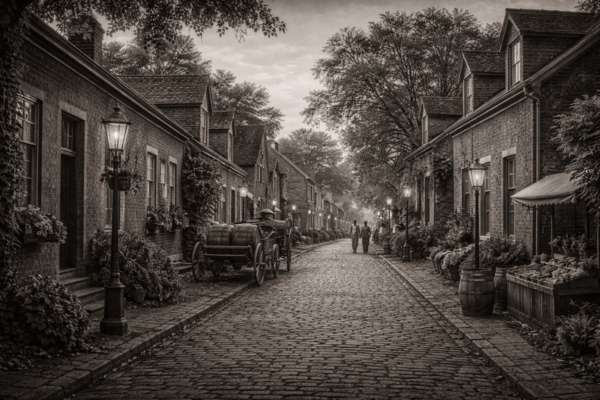
By the 1860s, German Village was a world unto itself, a place where the old language still rang out in the markets and traditions from the homeland found fertile soil in which to grow.
Tragedy and Turmoil
The Great War changed everything. When America entered the conflict in 1917, German heritage transformed overnight from a point of pride into a mark of suspicion. Street names were changed. German-language newspapers shuttered. Families who had called this neighborhood home for generations found themselves viewed as potential enemies.
The cultural suppression cut deep, severing connections to identity and community that had sustained residents through decades of struggle. What anti-German sentiment began, economic decline finished. Through the middle decades of the 20th century, German Village crumbled. Buildings fell into disrepair. Demolition crews eyed the aging brick structures with hungry interest.
The neighborhood came within a breath of total destruction before preservation efforts in the 1960s pulled it back from the brink. But by then, much had already been lost. Old cemeteries had been paved over as the city expanded. Graves were disturbed, relocated, or simply forgotten beneath new construction. The dead, it seemed, were not consulted about these changes.
Layers of Loss
The immigrant experience was never gentle, and German Village bears the invisible scars of that hardship. Cholera swept through the crowded streets more than once, claiming lives with terrifying speed. Infant mortality rates in the 19th century meant that nearly every family knew the particular grief of a tiny coffin.
Workers died in brewery accidents, crushed beneath equipment or scalded by burst pipes. Poverty claimed others, slowly and without mercy. The emotional residue of so much suffering, paranormal researchers suggest, does not simply evaporate. It seeps into the brick and mortar, pooling in corners and basements, waiting for the right conditions to make itself known.
Reported Hauntings
The Spirits of Schiller Park
The bronze statue of Friedrich Schiller has watched over the park bearing his name since 1891. By day, the German poet gazes contemplatively across lawns where families picnic and children play. By night, witnesses say, he is not alone.
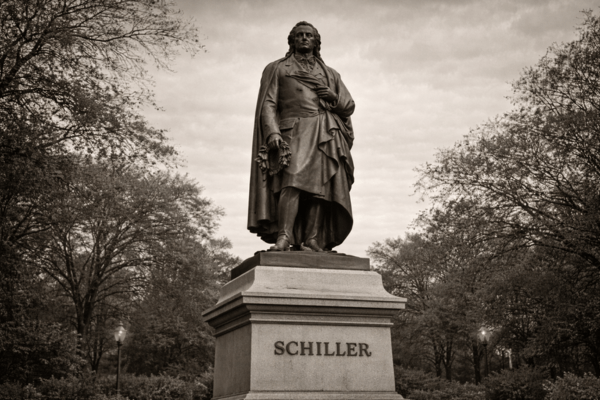
Apparitions have been reported near the statue and among the ancient trees that ring the park’s perimeter. They appear most often in the liminal hours, those gray moments between dusk and true dark when the boundaries between worlds grow thin. Some describe translucent figures in period clothing, walking paths that may no longer exist. Others report something more unsettling: the sound of voices speaking German, carrying across the empty grass from no discernible source.
The words are indistinct, conversational in tone, as though the speakers are simply continuing discussions interrupted more than a century ago.
Restless Souls of Forgotten Graves
Beneath the charming streets of German Village lie secrets that no historic marker acknowledges. Rumors persist of unmarked graves hidden under buildings, sidewalks, and roadways, the remnants of small family burial plots and church cemeteries that urban development chose to ignore rather than properly relocate.
Those who work in certain buildings report phenomena that defies easy explanation. Cold spots bloom suddenly in rooms with functioning heating systems. The temperature drops so dramatically that breath becomes visible, then returns to normal seconds later. Some business owners have learned to simply accept these occurrences, attributing them to the building’s unknown occupants.
The spirits, some believe, are not malevolent. They are confused, perhaps, their rest disturbed by construction they never consented to, wandering in search of graves that no longer exist.
The Phantom of the Book Loft
The Book Loft of German Village occupies a pre-Civil War building that has served countless purposes over its long existence. Today, it houses thirty-two rooms of books connected by narrow doorways and creaking staircases, a labyrinth that delights bibliophiles and, apparently, at least one permanent resident.
Staff members speak in hushed tones about the experiences they cannot explain. Footsteps echo through empty rooms after closing time, measured and deliberate, as though someone is browsing the shelves. Books slide from their places and tumble to the floor when no living hand has touched them. Security systems capture nothing, yet the sounds continue.
Most intriguing are the reports of a spectral woman seen wandering the deeper rooms of the store. She appears solid at first glance, dressed in clothing that suggests the late 1800s, her attention fixed on something only she can see. Then she rounds a corner into a dead-end room and simply vanishes, leaving only the faint impression of presence and the lingering chill of her passage.
Brewery Ghosts
German Village once boasted numerous breweries, their copper kettles and vast storage cellars fueling both the local economy and the neighborhood’s social life. Prohibition brought that era to a violent end, but the buildings remained, converted to other purposes while retaining the bones of their original construction.
Workers died in these places during the brewing years, victims of industrial accidents in an age before safety regulations. Others met their ends during Prohibition, when the brewing went underground and attracted a more dangerous element. Former brewery buildings throughout the village are said to harbor spirits of those who perished within their walls.
Current occupants report the smell of hops and malt wafting through spaces that have not housed brewing equipment in nearly a century. Shadow figures move through basement areas, visible only in peripheral vision, gone when confronted directly.
Haunted Hotspots Within the Location
Schiller Park After Dark
The park transforms when darkness falls. Shadowy paths wind beneath the canopy of aged trees, their branches reaching overhead like grasping fingers. The Schiller statue becomes a silhouette against the ambient city glow, its contemplative pose taking on an almost watchful quality.
Certain benches near the statue have developed reputations among those who track such things. Visitors report feeling suddenly observed, a prickling awareness along the back of the neck that has nothing to do with the autumn wind. The sensation passes as quickly as it arrives, leaving only questions.
The Book Loft of German Village
Not all thirty-two rooms carry the same atmosphere. The front sections feel bright and welcoming, filled with the comforting presence of countless books. But venture deeper into the maze, past the children’s section and through the narrow doorway into the older portions of the building, and the air changes.
Rooms in the back of the store feel heavier somehow, charged with something that resists easy definition. These are the spaces where phenomena cluster, where the spectral woman has most often been seen, where books seem most inclined to rearrange themselves.
Brick Basements and Hidden Tunnels
Rumors of underground tunnels connecting German Village buildings have circulated for generations. Some dismiss these stories as urban legend. Others point to the brick-lined basements that do exist beneath many structures, spaces that predate the current buildings and hint at a more extensive subterranean network.
Those who have spent time in these underground spaces report consistent experiences. An oppressive feeling settles over visitors, a weight on the chest that has nothing to do with air quality. Shadow figures move at the edges of vision. The sense of not being alone becomes impossible to shake, even when flashlight beams reveal nothing but empty brick and cobwebs.
Historic Homes on Third Street
The private residences lining Third Street carry their histories behind closed doors. Current homeowners occasionally share their experiences with trusted friends, tales of footsteps in empty upstairs hallways, of faces glimpsed in windows that should show only curtains, of personal objects moved overnight by hands that leave no fingerprints.
The hauntings seem benign, for the most part. Former residents checking on their homes, perhaps, unable to fully relinquish the spaces they loved in life.
Visiting the Site Today
German Village welcomes visitors year-round, its brick streets and historic architecture open to anyone who wishes to explore. The neighborhood remains a living community, filled with restaurants, shops, and galleries alongside the private homes that give it character.
Local tour companies offer ghost walks on a seasonal basis, typically concentrated in the autumn months when the atmosphere reaches peak eeriness. These guided experiences provide historical context alongside the paranormal tales, weaving fact and legend into compelling narratives.
Independent visitors will find the neighborhood most atmospheric at dusk, when the gas lamps begin their nightly vigil and shadows pool between the buildings. Autumn evenings, with their early darkness and possibility of fog, create conditions that seem to amplify the neighborhood’s haunted character.
Respectful exploration remains essential. Many of the most atmospheric buildings are private residences whose owners deserve their privacy. The spirits, too, perhaps deserve a measure of respect, whatever their current state of existence might be.
Closing Scene
Night has fully descended now, and a lone figure walks the cobblestones beneath gas lamps that cast pools of amber light against the creeping mist. The fog curls between buildings, softening the hard edges of brick and iron, transforming the familiar into something ancient and strange.
Somewhere nearby, a door creaks shut in a building that shows no lights, no signs of occupation. The sound carries clearly through the still air, then fades, leaving only the tap of footsteps on stone and the distant hum of the modern city that surrounds this preserved pocket of the past.
In German Village, history is preserved in more than architecture. Some say the old residents never truly left.