
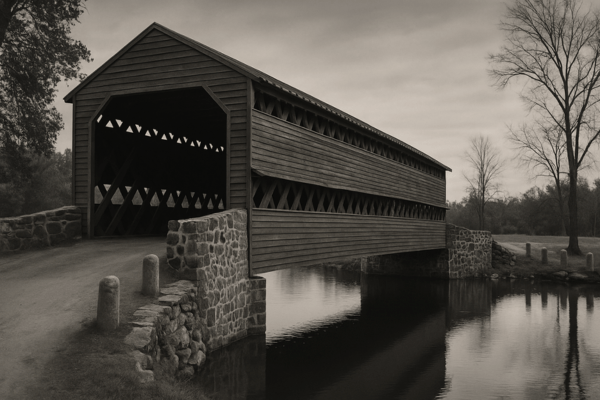
The wooden structure stretches across Marsh Creek like a tunnel through time. Moonlight filters through the gaps in the weathered boards, casting long shadows across the dirt path. The bridge’s dark interior beckons visitors forward, but something in the air makes them hesitate. A cold wind whispers through the beams. The distant creek murmurs below. And somewhere in the darkness, the past refuses to stay buried.
This is Sachs Covered Bridge, one of Gettysburg’s most haunted landmarks. Built before the Civil War, it stands as a silent witness to one of America’s bloodiest conflicts. But unlike other historic structures that have faded into peaceful retirement, Sachs Bridge remains restless, active, and deeply disturbed by the events of July 1863.
Soldiers crossed this bridge fleeing for their lives. Some never made it to the other side. Others were hanged from its very beams. And on certain nights, when the moon hangs low and the air grows still, visitors claim they can still hear the footsteps of men long dead, still trying to make their escape across this haunted crossing.
The History Behind the Boards
Sachs Covered Bridge was constructed in 1854, nine years before the Battle of Gettysburg would transform the peaceful Pennsylvania countryside into a battlefield. Built by local craftsmen using the sturdy Town lattice truss design, the bridge served as a vital crossing point over Marsh Creek, connecting farmers, families, and travelers moving through Adams County.
The covered design wasn’t just for aesthetics. The roof and walls protected the wooden structure from rain and snow, extending its lifespan considerably. At 100 feet long, the bridge could accommodate wagons, horses, and foot traffic, making it an essential piece of local infrastructure.
When war came to Gettysburg in the summer of 1863, Sachs Bridge suddenly found itself in the path of two massive armies. Both Union and Confederate forces used the crossing during the three-day battle and its chaotic aftermath. Thousands of boots thundered across its boards. Wagons loaded with ammunition, supplies, and wounded soldiers creaked over Marsh Creek. The peaceful bridge became a wartime artery, pulsing with the desperate energy of men fighting for survival.
The bridge survived the war, but decades of neglect nearly claimed what bullets could not. By the late 20th century, Sachs Bridge had fallen into dangerous disrepair. Recognizing its historical significance, local preservationists launched a restoration effort. Today, the bridge stands much as it did in 1863, a beautifully maintained relic of a darker time. But restoration couldn’t erase the memories soaked into its timbers or silence the voices that still echo through its covered interior.
Ready For More Ghost Hunts?
Check Out Our Ghost Tours of GettysburgThe Darkness During the Civil War
Retreat of the Confederate Army
July 4, 1863. The Battle of Gettysburg had ended in devastating defeat for General Robert E. Lee’s Army of Northern Virginia. As rain began to fall, Confederate forces started their agonizing retreat southward, desperate to escape Union pursuit and reach the safety of Virginia.
Sachs Covered Bridge became a critical escape route. Thousands of wounded, exhausted, and demoralized Confederate soldiers funneled toward the crossing, creating a choking bottleneck of chaos and fear. Wagons piled high with injured men struggled through the mud. Officers shouted orders. Horses panicked. The bridge, designed for peaceful rural traffic, groaned under the weight of a defeated army in full retreat.
For the men crossing Sachs Bridge that terrible night, every step carried the weight of survival. Union cavalry could appear at any moment. The wounded cried out in pain with each jolt of the wagon wheels. Some soldiers, too injured to continue, were left behind in the woods surrounding the creek. The bridge became a passage between life and death, hope and despair, freedom and capture.
The emotional intensity of those hours left an indelible mark. Fear, pain, desperation, and death saturated the very boards of the bridge. And according to countless witnesses over the past 160 years, some of that energy never left.
The Hangings at Sachs Bridge
Among the darkest legends associated with Sachs Covered Bridge are the stories of executions carried out within its shadowy interior. According to local accounts passed down through generations, three Confederate soldiers met their end here, hanged from the bridge’s sturdy beams.
The details vary depending on who tells the story. Some versions claim the men were deserters, caught fleeing the battle and executed as an example to other soldiers considering abandoning their posts. Other accounts suggest they were spies or enemy scouts captured behind Confederate lines. Still others propose they were Union soldiers in disguise, discovered and hanged by retreating Confederates.
What remains consistent across all versions is the image itself: three bodies swaying from ropes tied to the bridge’s overhead beams, their shadows cast long across the wooden floor by lantern light or moonlight filtering through the gaps. Whether the executions actually occurred or evolved from wartime rumors and post-battle folklore, the story has become inseparable from the bridge’s haunted reputation.
Many paranormal investigators believe that violent death, especially execution, can bind a spirit to a location. If men truly died here at the end of a rope, their final moments of terror and injustice may have imprinted themselves permanently into the structure of Sachs Bridge.
The River of Ghosts
Marsh Creek, flowing gently beneath Sachs Covered Bridge, carries its own dark history from the Civil War. Witnesses from the battle’s aftermath reported seeing bodies in the water, soldiers who had been shot, drowned, or simply collapsed and fallen from the bridge during the chaotic retreat.
Some wounded men, unable to walk and too injured to help, were reportedly placed near the creek’s edge and left behind as their units fled southward. Others may have sought the water hoping to ease their pain or quench their thirst, only to succumb to their injuries at the creek’s muddy banks.
The combination of death above and below the bridge created what some paranormal researchers call a “layered haunting.” The structure itself witnessed executions and desperate crossings, while the water below received the bodies of the fallen. Together, they form a complete picture of tragedy, a place where suffering occurred on multiple levels simultaneously.
Local legends speak of the creek running red with blood in the days after the battle. While likely an exaggeration, the image captures the emotional truth of what Marsh Creek witnessed. And today, visitors standing on Sachs Bridge often report an overwhelming sense of sadness when looking down at the water, as if the creek itself remembers what it received all those years ago.
The Hauntings of Sachs Covered Bridge
The Smell of Pipe Tobacco
One of the most frequently reported phenomena at Sachs Covered Bridge is also one of the most distinctive: the sudden, unmistakable smell of burning pipe tobacco drifting through the covered interior. Visitors entering the bridge often stop mid-step as the scent washes over them, thick and pungent, as if someone had just exhaled a mouthful of smoke directly in front of them.
The smell appears without warning and vanishes just as quickly, usually lasting only 15 to 30 seconds. It’s been reported in all weather conditions, at different times of day, and by people visiting alone or in groups. The scent doesn’t drift or dissipate naturally like real smoke would. Instead, it simply exists for a moment, then ceases completely.
Some witnesses describe a slightly different odor: sulfur or gunpowder mixed with tobacco. This variation might connect to Civil War-era soldiers, who would have carried both tobacco for personal use and gunpowder for their weapons. The combination of smells could represent phantom memories of men taking a nervous smoke break while guarding the bridge or pausing during their retreat to light their pipes despite the danger.
No modern source for the tobacco smell has ever been identified. The bridge is located in a relatively remote area with minimal foot traffic, and the scent appears even when investigators confirm no one else is present for hundreds of yards in any direction.
Disembodied Voices and Footsteps
Sound phenomena at Sachs Covered Bridge are perhaps the most unnerving experiences visitors encounter. The most common auditory manifestation is footsteps: the distinct sound of boots walking across the wooden floor of the bridge, echoing through the covered space with remarkable clarity.
What makes these phantom footsteps particularly disturbing is their proximity. Witnesses don’t hear them in the distance or at the far end of the bridge. They hear them right behind them, sometimes just a few feet away. People describe turning around expecting to see another visitor, only to find the bridge completely empty. Some have reported the footsteps matching their own pace, as if an invisible companion is walking alongside them through the darkness.
The quality of the sound varies. Sometimes it’s the heavy clunk of military boots striking the boards with purpose. Other times it’s a slower, dragging shuffle, like someone wounded or exhausted struggling forward. Occasionally, multiple sets of footsteps can be heard simultaneously, suggesting phantom groups of soldiers still making their retreat across the bridge.
Voices accompany the footsteps. Witnesses report hearing:
- Whispered prayers or frantic murmurs
- Short military commands: “Move!” “Keep going!” “Hurry!”
- Pained groans and labored breathing
- Urgent conversations in the distance that cease when approached
EVP (Electronic Voice Phenomena) recordings conducted at the bridge have captured voices that weren’t audible to human ears during the recording. These often include single words or short phrases in what sound like period-appropriate accents and terminology.
Full-Bodied Apparitions
Visual manifestations at Sachs Covered Bridge range from subtle shadow movements to fully detailed apparitions that witnesses initially mistake for living people. The most common sightings occur at the bridge’s entrances, where dark figures appear silhouetted against the lighter background beyond.
These shadow people typically stand motionless, appearing to watch or wait. Witnesses approaching the bridge sometimes see a figure at the far end, only to have it vanish as they enter the covered section. The apparitions don’t fade gradually or walk away. They simply cease to exist between one blink and the next.
More detailed sightings include soldiers in period uniforms. Witnesses describe:
- A Confederate soldier standing near the side wall, his face gaunt and exhausted
- Groups of men in gray or butternut uniforms clustered near the center of the bridge
- A lone figure in Union blue standing outside the bridge, staring down at the creek
The most famous visual phenomenon is the “hanging soldier” captured in numerous photographs taken inside the bridge. When these images are reviewed, they reveal what appears to be a human silhouette suspended from the overhead beams, despite no one being visible to the naked eye when the photo was taken. The figure appears in different locations within the bridge, suggesting either multiple entities or a single spirit re-enacting its death in various positions.
Some apparitions interact with witnesses. People have reported making eye contact with a soldier only to have him raise his hand, whether in warning, greeting, or plea, before disappearing. Others have seen figures that seem aware of modern visitors, turning to watch them pass before fading into the wooden walls.
Touches, Tugs, and Temperature Drops
The physical sensations experienced at Sachs Covered Bridge move beyond the merely observational into the realm of direct contact. Visitors frequently report being touched by invisible presences, usually in ways that feel deliberate and purposeful rather than accidental.
Common tactile experiences include:
Cold spots: Sudden drops in temperature that affect specific body parts rather than the general environment. People describe icy air wrapping around their ankles as if something is crouching near their feet, or freezing bands across their waist as though unseen hands are gripping them.
Tugs and pulls: Clothing being yanked gently from behind, hair being touched, or arms being grasped as if someone is trying to get attention or prevent forward movement.
Brushes against skin: The sensation of someone walking past closely, their coat or body brushing against visitors despite no one being visible.
Pressure: An invisible weight settling on shoulders or the feeling of someone leaning against visitors from behind.
Electronic equipment experiences dramatic effects at the bridge. Fully charged camera batteries drain to empty within seconds. Digital recorders malfunction. Flashlights flicker or fail completely despite fresh batteries. Cell phones lose power rapidly or shut down spontaneously. The electromagnetic disturbances suggest a strong paranormal presence drawing energy from available sources.
Some visitors report physical symptoms while on the bridge: sudden nausea, dizziness, intense anxiety, or overwhelming sadness that dissipates the moment they leave the structure. These sensations may represent empathic connections to the traumatic events that occurred here, or they might indicate spirits attempting to communicate their own final moments of fear and pain.
Paranormal Investigations & Famous Encounters
Sachs Covered Bridge has become a pilgrimage site for paranormal investigators, earning features on multiple television programs dedicated to exploring America’s most haunted locations. Professional ghost hunting teams and casual enthusiasts alike have documented remarkable evidence at this location, contributing to its reputation as one of Gettysburg’s most actively haunted sites.
Television investigations have captured compelling footage and audio at the bridge. Multiple shows have recorded:
- EVP sessions yielding clear voices responding to investigators’ questions
- Thermal imaging cameras detecting human-shaped heat signatures with no physical bodies present
- Night vision footage showing shadow figures moving through the bridge
- Electromagnetic field (EMF) meters spiking dramatically in specific locations with no electrical sources nearby
Notable EVP recordings from Sachs Bridge include:
- A man’s voice urgently saying “Move” when investigators asked if anyone was present
- A pained voice whispering “Help me” during a quiet recording session
- What sounds like multiple men talking in low voices, with individual words like “water,” “wait,” and “gone” discernible
- A child’s voice, unexpected given the military nature of most manifestations, saying something that sounds like “Mama”
Photographic evidence collected over decades shows consistent anomalies:
- Glowing orbs of various sizes appearing in clusters, often near the overhead beams
- Mist or fog forming in human shapes, particularly near the bridge’s entrances
- The aforementioned hanging figure appearing in photos taken from different angles
- Light anomalies that create the appearance of people leaning over the side railings
- Shadow figures captured in broad daylight, where shadows shouldn’t logically exist
Professional investigators often cite Sachs Bridge as producing some of the most consistent and compelling evidence they’ve encountered. Unlike locations where activity seems sporadic or isolated to specific dates, the bridge demonstrates paranormal phenomena during nearly every investigation, regardless of season, weather, or time of day.
Many experienced paranormal researchers report feeling an overwhelming sense of presence at the bridge. Even skeptical team members often leave convinced something unusual is occurring at the site. The consistency and variety of phenomena, combined with the documented historical trauma, make Sachs Covered Bridge a textbook case of what paranormal researchers call an “intelligent haunting,” where spirits seem aware of and responsive to the living.
Visiting Sachs Covered Bridge Today
What the Bridge Looks Like Now
Sachs Covered Bridge today stands as a beautifully preserved example of 19th-century engineering, its red wooden exterior weathered but sturdy, its lattice truss design still clearly visible through the open sides. The structure measures 100 feet long and sits approximately 15 feet above Marsh Creek, which flows peacefully beneath its timbers.
Approaching the bridge, visitors first notice its isolation. Unlike Gettysburg’s downtown historic sites, Sachs Bridge occupies a quiet rural location surrounded by woods and farmland. The modern world feels distant here. No traffic noise intrudes. Houses and buildings are few and far between. The setting allows visitors to imagine how the landscape might have looked in 1863.
The bridge’s interior creates an immediate atmospheric shift. Daylight streams through the gaps between boards, creating vertical stripes of light and shadow across the wooden floor. The ceiling rises overhead, with massive beams spanning the width, the same beams from which soldiers were allegedly hanged. The walls show the wear of over 160 years: weathered wood, gaps that reveal the creek below, and the occasional graffiti from visitors less respectful than they should be.
Walking across the bridge, your footsteps echo hollowly. The boards creak and shift slightly under your weight. The sound of the creek becomes muffled inside the covered section, replaced by the acoustic qualities of the enclosed space. It’s easy to imagine frightened soldiers hurrying through this same darkness, their equipment rattling, their breathing heavy with exhaustion and fear.
The surrounding area offers paths for exploration. Woods flank both sides of the creek, dense enough to feel isolated but maintained enough to walk through safely. The creek itself is shallow and gentle, though it’s not difficult to imagine it swollen with rain as it was during the Confederate retreat.
Best visited at dusk or during the “golden hour” just before sunset, the bridge takes on an especially eerie quality as shadows lengthen and details become obscured. Moonlit nights provide the most atmospheric experience, with silver light filtering through the gaps and creating dramatic contrasts throughout the interior.
Tips for Ghost Seekers
For those hoping to experience paranormal activity at Sachs Covered Bridge, experienced investigators offer these practical suggestions:
Timing your visit:
- Late evening and night produce the most activity, particularly between 10 PM and 2 AM
- Overcast days with fog or mist seem to amplify phenomena
- The anniversary dates of the Battle of Gettysburg (July 1-3) see increased reports
- Dawn visits can be productive, as the transition between night and day is considered a “liminal” time
Essential equipment:
- Audio recorder: EVPs are among the most common phenomena at the bridge
- Flashlight with extra batteries: essential for safety, though expect batteries to drain quickly
- Camera or video device: visual anomalies appear frequently in photos
- EMF meter: for those serious about investigation, electromagnetic field spikes are documented here
- Warm clothing: even in summer, cold spots can be intensely chilling
Investigation techniques:
- Walk the bridge slowly, pausing frequently to listen for footsteps or voices
- Spend extended time standing still in the center: many witnesses report the sensation of being watched develops gradually
- Ask questions aloud during EVP sessions: “What is your name?” “Why are you here?” “Can you show us a sign?”
- Pay attention to sudden changes in emotion, temperature, or atmosphere
- Take multiple photos from the same position: anomalies often appear in one shot but not others taken seconds apart
Maximizing your experience:
- Visit alone or with a small, quiet group: large crowds disperse the energy
- Minimize your own noise: many sounds are subtle and easily missed
- Turn off cell phones and electronic devices unless using them for investigation
- Remain respectful: speak to any presences with courtesy and acknowledgment
- Trust your instincts: if you feel uncomfortable or sense a presence, you probably should
What to watch for:
- Tobacco scent appearing suddenly
- Footsteps echoing behind you when you stop walking
- Shadow figures at the bridge entrances
- Cold air wrapping around specific body parts
- Battery drainage despite fresh power sources
- Feelings of being touched or having your clothing tugged
- Voices or whispers in the darkness
Many investigators recommend simply sitting quietly in the bridge for 15-20 minutes without speaking or using equipment. This “passive observation” often produces the most profound personal experiences, as you allow the environment and any presences to become comfortable with you rather than immediately bombarding them with questions and devices.
Respect and Safety
While exploring Sachs Covered Bridge, visitors must balance their enthusiasm for paranormal investigation with respect for both the historical site and their own safety.
Structural respect:
- Do not climb on the beams, railings, or any part of the bridge structure
- Avoid touching or leaning against weakened sections of wood
- Do not add graffiti or markings of any kind
- Leave no trash or evidence of your visit
- Do not remove any pieces of wood or other materials as “souvenirs”
Personal safety:
- Never visit completely alone, especially at night: bring at least one companion
- Watch your footing: the bridge floor can be uneven, and gaps exist between boards
- Be aware of the edges: falling from the bridge into the creek below could cause serious injury
- Stay on established paths: the woods surrounding the bridge can be treacherous in darkness
- Tell someone your plans: let friends or family know you’ll be visiting and when you expect to return
- Bring a phone for emergencies, even if you plan to keep it off during investigation
- Be cautious of wildlife: the rural location means encounters with animals are possible
Respectful investigation:
- Remember you’re visiting a site where real people died traumatic deaths
- Avoid aggressive or taunting language when attempting spirit communication
- Don’t assume all sounds or experiences are paranormal: animals, wind, and natural settling create noises
- If you feel genuinely frightened or threatened, leave immediately: your safety matters more than evidence
- Consider the impact on local residents: this is a real community, not just a haunted attraction
Legal considerations:
- The bridge is on public land and open to visitors, but check current access hours
- Do not trespass on adjacent private property
- Be considerate of noise levels, especially late at night
- Some ghost tour companies have permission for commercial activities: individual visitors should remain respectful of these businesses
The most successful and meaningful visits to Sachs Covered Bridge come from those who approach the site with a balance of curiosity and reverence. The spirits here, if they exist, were once living people who experienced terrible fear and pain. Treating the location and its history with appropriate solemnity creates an environment where genuine paranormal experiences are more likely to occur.
Why Sachs Bridge Holds So Much Energy
Among Gettysburg’s many haunted locations, Sachs Covered Bridge stands out for the intensity and consistency of its paranormal activity. Understanding why this particular structure remains so deeply haunted requires examining the convergence of factors that transformed a simple rural crossing into one of America’s most actively haunted sites.
Concentrated trauma in a confined space: Unlike a battlefield spread across open ground, Sachs Bridge forced thousands of frightened, wounded, and desperate men into a narrow, enclosed space. The 100-foot-long covered structure became a pressure point where fear intensified. Soldiers couldn’t spread out or escape the sounds and sights of suffering around them. They were trapped in a wooden tunnel with their terror and their dying comrades.
The psychology of retreat: Advancing into battle, soldiers operated on adrenaline and determination. But retreat carries a different psychological weight. The men crossing Sachs Bridge weren’t marching toward glory or fighting with hope. They were fleeing in defeat, exhausted, wounded, and demoralized. This emotional state may have created a particularly vulnerable psychic imprint, as their guards were down and their raw emotions exposed.
Execution and injustice: If the hanging stories hold any truth, they add a layer of violent death to the site’s history. Paranormal researchers consistently find that spirits who died suddenly, violently, or unjustly are more likely to remain earthbound. Execution combines all three factors. Men hanged at Sachs Bridge would have died in terror, pain, and possibly outrage at their fate, creating ideal conditions for a haunting.
Water as a conductor: Marsh Creek flowing beneath the bridge may contribute to paranormal activity. Many paranormal theories suggest that water can amplify spiritual energy or serve as a conductor for psychic phenomena. The creek that received bodies and blood during the Civil War might continue to hold and transmit the emotional resonance of those events.
Wooden construction: The bridge’s wooden materials may retain emotional and psychic imprints more effectively than stone or modern materials. Wood is organic, porous, and reactive to environmental conditions. Some researchers theorize that natural materials can absorb and hold energy in ways that synthetic or highly processed materials cannot.
Continuous acknowledgment: Unlike battlefields that have become parks or homes built over tragedy, Sachs Bridge serves its original function. People still cross it, walk its boards, and experience the same physical space those Civil War soldiers occupied. This ongoing use may keep the spirits’ memories active rather than allowing them to fade into dormancy.
Liminal space: Bridges occupy a unique position in human psychology and folklore. They exist between two places, belonging fully to neither. This “in-between” quality makes them naturally liminal spaces, thresholds that straddle the boundary between different states of being. Many cultural traditions identify liminal spaces as places where the barrier between our world and the spiritual realm grows thin.
The weight of silence: After the chaos of war, Sachs Bridge returned to quiet isolation. The contrast between its wartime trauma and its current peaceful setting may contribute to its haunted nature. The spirits might still be processing the shift from violent chaos to eerie calm, unable to reconcile what they experienced with the tranquility that eventually returned.
Sachs Covered Bridge represents a perfect storm of factors that paranormal researchers associate with active hauntings: violent death, intense emotion, confined space, natural materials, water proximity, and continued human interaction. It’s not just that tragedy occurred here. It’s that every element necessary to imprint that tragedy permanently into the physical location came together in this single wooden structure.
The bridge doesn’t just remember what happened. It holds those memories in its timbers, releases them in phantom footsteps and tobacco smoke, and shows them to visitors who cross its boards more than 160 years after the guns fell silent.
Closing Scene: A Step into the Darkness
The sun has set completely now, and Sachs Covered Bridge disappears into shadow. Only the pale light of a rising moon illuminates its outline, creating a dark rectangle against the slightly lighter sky beyond. The creek murmurs its endless conversation with the banks below.
You step onto the wooden floor, and immediately your footsteps sound different. Hollow. Echoing. The sound bounces off the walls and ceiling before dying in the darkness ahead. You walk slowly, your flashlight beam cutting through the black interior, catching dust motes drifting in the still air.
Halfway across, you stop. Listen.
There.
Behind you, another set of footsteps. Heavy boots on wooden boards. Getting closer. You turn, shining your light back toward the entrance.
Nothing.
The footsteps stop when you stop. But you can feel it now, the sensation of not being alone. Something is here with you in the darkness, standing just beyond your light’s reach, watching, waiting, remembering.
A sudden wind rushes through the bridge, cold enough to make you gasp. It carries with it a smell: tobacco, sulfur, and underneath it all, something organic and old. The wind passes as quickly as it came, and in the silence that follows, you hear it.
A voice. Faint but unmistakable, drifting from the far end of the bridge.
“Wait.”
You look toward the sound, and there, silhouetted against the moonlit opening, stands a figure. Tall. Still. Wearing what looks like a long coat. For three heartbeats it remains, solid enough to be real. Then it leans back slightly, tilts its head, and fades like morning mist burned away by sunlight.
Your flashlight flickers. Your hands are shaking. Behind you, the footsteps begin again, pacing back and forth across the boards, never coming closer but never leaving. A presence patrols this bridge still, walking its post, unable or unwilling to abandon its duty even in death.
You finish crossing, stepping out into the cool night air on the other side. The relief is immediate but incomplete. Because when you look back at the bridge’s dark interior, you see a shape moving through the shadows. And you realize the truth that so many others have learned at this haunted crossing:
At Sachs Covered Bridge, every step echoes with the footsteps of the fallen. The soldiers who crossed here in terror and pain never truly left. They walk the boards still, their boots ringing out through the darkness, their voices calling from the shadows, forever trapped in those desperate hours when this simple wooden bridge became a doorway between life and death.
And they’re waiting for you to cross it with them.