
The final curtain has fallen. The applause has faded into memory. Now the Bijou Theatre sits in velvet darkness, row upon row of empty seats facing a stage where a single ghost light burns against the black.
That solitary bulb casts its pale glow across carved wooden balustrades and gilded Victorian trim. Shadows pool in the corners, stretch along the aisles, and creep up walls that have absorbed more than a century of laughter, tears, and whispered secrets.
Standing as one of the oldest surviving theatres in Knoxville, Tennessee, the Bijou is a monument to the performing arts. Its stage has hosted vaudeville acts, silent film screenings, and countless live performances spanning generations.
But the Bijou carries a second identity beneath its elegant facade. Those who work within its walls speak of footsteps in empty corridors. Of voices rising from darkened auditoriums. Of figures that drift through the balcony seats long after the audience has departed.
Here, it seems, some performers and patrons from eras past never received their final curtain call.
Ready For More Ghost Hunts?
Check Out Our Ghost Tours of KnoxvilleHistorical Background
The Bijou Theatre opened its doors in 1909, but the ground beneath it holds memories far older and darker than its ornate interior suggests.
This corner of Knoxville has served as a gathering place since 1817, when the original Lamar House hotel rose on the site. For decades, the Lamar House welcomed travelers, politicians, and merchants passing through eastern Tennessee. Its rooms witnessed celebrations and sorrows, deals struck and hearts broken.
Then came the Civil War.
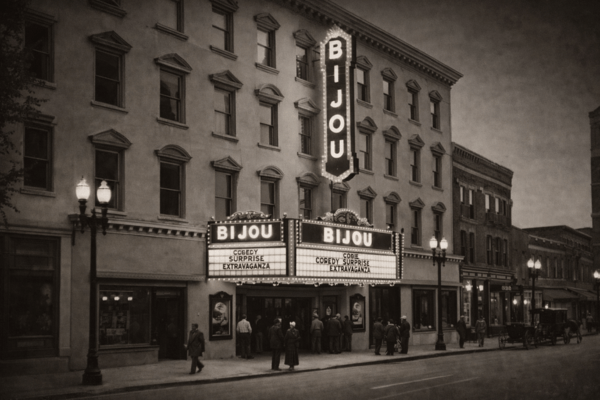
When conflict tore through Tennessee, the Lamar House transformed into something far grimmer than a hotel. Its parlors and guest rooms became makeshift hospital wards, filled with wounded soldiers from both Union and Confederate forces. The air grew thick with the smell of blood and chloroform. Men died in agony on cots hastily arranged where travelers once slept.
How many drew their final breaths within these walls remains unknown. What is certain is that suffering soaked into the very foundations of this place.
After the war, entertainment returned to the site. The space evolved through the decades, transitioning from a vaudeville house to a movie palace as the twentieth century progressed. By 1909, the Bijou Theatre emerged in its current form, designed to showcase the performing arts in grand Victorian style.
Yet something of the old Lamar House remained. Something restless. Something that had witnessed too much pain to simply fade away.
Over more than a century, the Bijou has accumulated layer upon layer of human emotion. Joy and grief. Triumph and tragedy. All of it concentrated within one space, pressing against the walls like a held breath waiting to be released.
Reported Hauntings
The Woman in White
She appears without warning in the upper levels of the theatre. A pale figure in a flowing white gown, moving through the balcony with the grace of someone who belongs there.
Witnesses describe her as luminous, almost translucent, gliding between the rows of seats as if searching for something lost long ago. She never speaks. She never acknowledges those who see her. She simply drifts, then vanishes like morning mist struck by sunlight.
Those familiar with the Bijou’s history believe she dates to the Civil War era, perhaps a nurse who tended to dying soldiers in the Lamar House hospital. Others suggest she may have been a patient herself, a woman who succumbed to illness or injury within these walls.
Whatever her origin, the Woman in White has become the theatre’s most recognized specter. Staff members speak of her with a mixture of unease and something approaching reverence. She has been here longer than any of them. She will remain long after they are gone.
The Phantom Stagehand
Backstage at the Bijou, the living are not always alone.
Crew members working late have reported heavy footsteps echoing through the corridors behind the stage. The sound is unmistakable: deliberate, purposeful, like someone going about their duties in the darkness. But when they investigate, the hallways stand empty.
Equipment has been found moved overnight. Props relocated from their assigned positions. Ropes coiled differently than they were left. Nothing destructive, nothing malicious. Simply the work of someone who believes they still have a job to do.
Some speculate the phantom stagehand is a remnant of the vaudeville era, a worker so devoted to the theatre that death itself could not end his shift. Others wonder if he might be even older, a spirit tied to the building’s foundations from the days when the Lamar House stood in its place.
Whoever he is, he takes his work seriously. And he shows no signs of retirement.
Disembodied Voices and Music
Perhaps the most unsettling phenomena at the Bijou involve sounds that have no source.
Staff members locking up for the night have heard applause rising from the empty auditorium. Not faint or distant, but full and enthusiastic, as if an audience of hundreds had gathered in the darkness to celebrate a performance no living person witnessed.
Laughter echoes through the corridors without explanation. Old music, scratchy and distant like a gramophone recording, drifts through the air before fading into silence.
Performers rehearsing on stage speak of whispers in the wings. Voices just below the threshold of comprehension, murmuring from the shadows as if offering critique or encouragement from another era entirely.
The Bijou, it seems, never truly empties. Even when every seat sits vacant and every light has been extinguished, the echoes of past performances continue to play on.
Haunted Hotspots Within the Location
Not all areas of the Bijou carry the same weight of supernatural activity. Certain spaces within the theatre have earned reputations as focal points for paranormal phenomena.
The balcony remains the Woman in White’s domain. Visitors ascending to the upper levels often report sudden drops in temperature, cold spots that seem to move through the space like invisible currents. The sensation of being watched prickles at the back of necks. And occasionally, in peripheral vision, a pale form drifts between the seats before dissolving into nothing.
The backstage area pulses with a different kind of energy. Theatre employees describe glimpsing shadowy figures in mirrors, shapes that appear for a heartbeat before vanishing when viewed directly. The air feels thicker here, heavier, as if the walls themselves remember every performer who ever waited nervously in the wings.
Beneath the theatre, the basement harbors the most unsettling atmosphere of all. These foundations date to the oldest incarnations of the site, perhaps even to the Lamar House era. The air down here carries a different quality. Sounds seem muffled, distorted. Footsteps echo strangely. Those who venture into the basement speak of an oppressive feeling, a sense of residual energy that has nowhere to go.
And then there is the stage itself.
Performers standing beneath the lights describe an unmistakable sensation of observation. Not from the empty seats, but from somewhere else entirely. As if unseen eyes were evaluating their every movement, their every line, their every note. The ghost light burns alone when the house goes dark, a tradition meant to ward off spirits. But at the Bijou, some wonder if the light serves instead as a beacon, drawing the theatre’s permanent residents to their favorite place.
Visiting the Site Today
The Bijou Theatre remains very much alive as a cultural institution. Its stage hosts regular live performances throughout the year, from concerts to theatrical productions to community events. The Victorian interior has been carefully preserved, offering visitors a glimpse into an era when entertainment was experienced in spaces designed to inspire awe.
For those drawn by the theatre’s supernatural reputation, occasional ghost tours and historical tours are offered. These events provide opportunities to explore the building’s hidden corners and learn its darker history. Checking local listings for scheduled tours is recommended, as availability varies throughout the year.
Attending an evening performance offers perhaps the most atmospheric experience. Arriving early allows time to wander the Victorian interior, to study the ornate details, and to sense the weight of history pressing in from all sides. As the house lights dim and the performance begins, it becomes easy to understand why some spirits might choose never to leave.
The Bijou functions as both a working theatre and a historic landmark. Those who visit should approach the space with appropriate respect, honoring both its artistic legacy and the lingering presences that call it home.
Closing Scene
The theatre empties. The performers depart. The audience scatters into the Knoxville night, carrying fragments of music and memory with them.
Inside the Bijou, silence descends like a velvet curtain. Row after row of empty seats face the darkened stage, where a single ghost light burns against the black. Its pale glow illuminates nothing but dust motes drifting in still air.
Somewhere in the balcony, a cold draft stirs without explanation. In the wings, a shadow moves where no shadow should exist. And if one listens closely, very closely, faint applause might be heard rising from the darkness.
In a theatre this old, every performance has an audience. Even when the living have gone home for the night, someone is always watching from the velvet dark.