
Moonlight spills across Town Street like cold silver, pooling in the spaces between the old gas lamps that still flicker along the walkway. The shadows they cast are long and restless, stretching across the Victorian facade of Kelton House as if reaching for something just beyond grasp.
The windows stare back at the night, dark and patient. Behind them, 170 years of memory press against the glass.
Standing among the modern bustle of downtown Columbus, Kelton House Museum remains a portal to another era. Its Greek Revival elegance speaks of wealth, refinement, and the careful cultivation of respectability that defined upper class Ohio society in the decades before the Civil War.
But elegance is only half the story.
This is a home that harbored secrets. A home where desperate souls fleeing bondage found sanctuary in hidden spaces. A home where four generations lived, loved, grieved, and ultimately died. And according to countless witnesses over the past five decades, it is a home where some of those souls never departed at all.
The living come here to learn history. But something in the shadows is still listening, still watching, still waiting for visitors who might stay just a moment too long after dark.
Ready For More Ghost Hunts?
Check Out Our Ghost Tours of ColumbusHistorical Background
The Kelton Family Legacy
In 1852, Fernando Cortez Kelton broke ground on what would become one of Columbus’s most distinguished residences. A successful merchant whose business interests stretched across the growing frontier economy, Kelton possessed both the means and the ambition to construct a home befitting his station.
The house rose from Town Street in graceful lines, its symmetrical facade and columned entrance announcing to all of Columbus that the Kelton family had arrived.
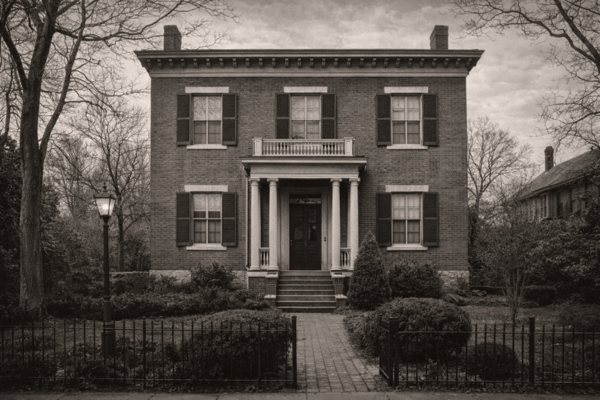
But Fernando Kelton was not merely a man of commerce. He and his family held fierce abolitionist convictions during an era when such beliefs carried genuine risk. The Kelton home became a station on the Underground Railroad, its hidden spaces offering temporary refuge to freedom seekers making their desperate journey north.
How many passed through remains unknown. Records of such activities were deliberately scarce, destroyed to protect both the helpers and the helped. What is known is that the Kelton family risked their reputation, their livelihood, and potentially their freedom to shelter strangers in their elegant home.
Four generations of Keltons would call this house home, from Fernando’s era through the twentieth century. The family line finally ended in 1975, when the last Kelton descendant passed away, leaving behind a residence heavy with accumulated memory.
A Home Marked by Loss
No house stands for over a century without accumulating its share of grief.
Multiple family members drew their final breaths within these walls. The upstairs bedrooms witnessed the slow fade of illness, the sudden shock of unexpected death, and the quiet vigils of those left behind. Each loss added another layer to the emotional sediment that seemed to settle into the very foundation.
The weight of the family’s abolitionist work added its own particular burden. The constant anxiety of harboring fugitives, the knowledge that discovery meant ruin, the emotional toll of witnessing human beings reduced to property and hunted like animals. These experiences leave marks that time cannot entirely erase.
Then came the Civil War, bringing fresh anxieties and fresh losses to a family already intimately acquainted with the costs of conscience.
When Kelton House became a museum in 1976, its curators preserved more than architecture and antiques. They inherited a space saturated with over a century of profound human experience. The beauty remained, certainly. But so did the sorrow, waiting in quiet corners for those sensitive enough to perceive it.
Reported Hauntings
The Lady of the House
She appears without warning, a figure in Victorian dress glimpsed in peripheral vision or spotted clearly at the end of a long hallway. By the time observers turn for a better look, she has already begun to fade, dissolving into the wallpaper patterns that once defined her world.
Staff members and visitors alike have reported encounters with what many believe to be one of the Kelton women, still making her rounds through the parlor and bedrooms where she spent her mortal years. Her silk dress rustles with a sound just below the threshold of certainty. The scent of lavender sometimes trails in her wake.
Those who have witnessed her describe a presence that feels protective rather than malevolent. She watches. She observes the strangers who now walk through her home. But she does not threaten. If anything, witnesses report a sense of being evaluated, as if the lady of the house is simply ensuring that proper decorum is maintained in her absence.
Perhaps she never accepted that her time here ended. Perhaps she simply cannot bring herself to abandon the rooms where her life unfolded in all its complexity. Whatever the reason, she remains, a guardian of a home that was taken from her family only by the final, unavoidable departure.
Phantom Footsteps and Voices
The footsteps begin on the upper floor when the building is empty.
Staff members working alone in the offices have frozen mid-task at the unmistakable sound of shoes crossing wooden floorboards directly above their heads. The rhythm is deliberate, unhurried, the casual pace of someone moving between rooms with no particular urgency. By the time anyone investigates, the upper floor is empty, the rooms undisturbed, the source of the footsteps vanished as if it never existed.
But it is the voices that truly unsettle.
Whispered conversations drift from empty rooms, too faint to discern individual words but clear enough in their cadence to suggest a dialogue in progress. The tone carries the warmth of family discussion, the easy back and forth of people who have known each other for years. Sometimes laughter punctuates the murmurs. Sometimes the voices drop to conspiratorial whispers, as if secrets are being shared that strangers should not overhear.
Open the door, and silence rushes in to fill the space where the conversation had been. The Keltons, it seems, do not appreciate interruption.
The Spirits of the Hidden
Not all the spirits that linger in Kelton House belonged to the family.
In certain areas of the home, particularly those connected to the Underground Railroad activities, visitors report experiences that transcend the merely strange and venture into the profoundly emotional. Sudden cold spots manifest without warning, dropping the temperature by degrees that seem impossible in the context of a climate-controlled building.
But temperature is the least of it.
Some visitors have been overcome by waves of intense emotion they cannot explain. Fear. Desperation. Exhaustion. The particular terror of being hunted. These feelings crash over unsuspecting guests with an intensity that leaves them shaken, sometimes moved to tears by sorrows that are not their own.
Others report sensations of profound gratitude, as if invisible presences are expressing thanks for sanctuary provided generations ago. The freedom seekers who passed through this house came here at the most desperate moments of their lives. Perhaps the intensity of that experience left an imprint that time cannot fully dissolve.
Their names are lost. Their faces are unknown. But something of their passage remains, echoing through rooms that once offered them their only hope of safety.
Haunted Hotspots Within the Location
The Parlor
The parlor served as the emotional heart of the Kelton home, the space where the family received guests, conducted business, celebrated milestones, and mourned their dead. Four generations of life concentrated in this single room, leaving layer upon layer of memory pressed into the walls like flowers in a forgotten book.
It remains the most active location for paranormal reports.
Apparitions are glimpsed near the windows, silhouettes that seem to be gazing out at a Town Street that no longer exists. Unexplained sounds manifest without warning: the rustle of fabric, the creak of furniture bearing weight that is not there, the soft clink of porcelain as if invisible hands are serving tea to guests who departed a century ago.
Tour guides have learned to watch visitors closely in this room. Something about the parlor seems to thin the barrier between then and now, allowing sensitive individuals to perceive things that others miss entirely.
The Upstairs Bedrooms
Ascending the staircase brings visitors closer to the most intimate spaces of Kelton family life. It also brings them closer to something that does not want to be forgotten.
Cold spots drift through the upstairs bedrooms like invisible currents, settling in corners and beside doorways before dissipating as mysteriously as they arrived. The sensation of being watched is pervasive, a prickling awareness at the back of the neck that suggests unseen eyes tracking every movement.
Objects move without explanation. A hairbrush found facing the wrong direction. A drawer left slightly open when it had been firmly closed. Small displacements that could be dismissed individually but that accumulate into a pattern suggesting intention.
These were the rooms where Kelton family members passed from life into whatever awaits beyond. The beds where they were born. The beds where they died. That kind of significance does not simply evaporate when the bodies are removed.
The Basement and Hidden Spaces
Below the elegant public rooms lies another world entirely.
The basement and the hidden spaces connected to Underground Railroad activity carry an atmosphere distinct from the rest of the house. The air feels heavier here, weighted with a solemnity that has nothing to do with the lack of natural light. Visitors descending into these areas often report a shift in their emotional state, a sudden awareness of significance that transcends architecture.
Feelings of urgency sweep through without warning. A desperate need to move, to hide, to escape. The fear of capture mingles with fragile hope as visitors experience emotional echoes of those who once sheltered here in the most dangerous circumstances imaginable.
Alongside the fear, many report sensations of profound gratitude and peace. As if those who passed through have left behind not only their terror but also their relief at finding, however briefly, a place where they were seen as human beings deserving of protection.
Visiting the Site Today
Kelton House Museum welcomes visitors year round, offering guided tours that explore the architectural beauty, historical significance, and yes, the paranormal reputation of this remarkable property. Knowledgeable guides lead guests through the same rooms where the Kelton family lived their complex lives and where some believe they remain.
For those specifically seeking supernatural encounters, the museum offers special ghost tours and Halloween season events that embrace the building’s haunted legacy. These evening programs allow visitors to experience the house after dark, when the shadows deepen and the old floorboards seem to creak with greater purpose.
The most atmospheric visits occur at dusk or during these evening events, when the transition between day and night mirrors the house’s own position between past and present. As natural light fades and the gas lamps cast their flickering illumination, Kelton House reveals a character that bright afternoon sun tends to obscure.
Those who visit should remember that this is more than a haunted attraction. It is a historic landmark where real people lived, struggled, and died. It is a place where acts of profound courage were performed in secret. The spirits that may linger here deserve the same respect accorded to any host welcoming strangers into their home.
Closing Scene
The final tour of the evening concludes. Visitors file out into the cool night air, their voices fading as they disperse toward cars and restaurants and the comfortable certainty of their modern lives.
Inside, a staff member makes one last pass through the rooms, switching off lights, checking locks, restoring the house to its resting state. Darkness claims the parlor first, then the dining room, then the hallways that connect them like arteries through a body that refuses to fully die.
The stairs creak, though no one walks upon them.
Somewhere on the upper floor, a floorboard groans beneath invisible weight. And in the deepening shadows at the end of a hallway, there is just the faintest rustle of silk, the suggestion of movement where nothing should move, a presence glimpsed at the edge of perception before it vanishes around a corner that leads to rooms the living can no longer enter.
In Kelton House, the past never truly says goodbye. It simply waits in the shadows for the next visitor to listen.