
The gas lamps flicker like memories refusing to fade. Against the Columbus skyline, the Ohio Statehouse rises in limestone grandeur, its massive columns casting long shadows across the empty plaza. At night, when the last legislative aide has gone home and the tourists have dispersed, something shifts in the atmosphere around this Greek Revival monument.
The building stands as a seat of power, a temple to democracy, a place where laws are written and futures are shaped. But beneath the polished marble floors and within the thick stone walls, another kind of history breathes. A darker history. One stained by war, grief, and death.
This is where Abraham Lincoln lay in state while a nation wept. Where Union soldiers marched off to uncertain fates. Where workers toiled for over two decades, some never living to see their labor completed. The Ohio Statehouse has witnessed more than legislation. It has witnessed profound human suffering. And according to countless witnesses over the decades, that suffering has never truly left.
Ready For More Ghost Hunts?
Check Out Our Ghost Tours of ColumbusHistorical Background
Construction and Purpose
Ground was broken in 1839, and no one could have predicted the structure would take twenty two years to complete. Economic depressions, design disputes, and the sheer ambition of the project stretched the construction timeline to nearly a quarter century. Workers came and went. Architects were hired and dismissed. Political fortunes rose and fell.
The building was designed in the Greek Revival style, its columns and proportions meant to evoke the democratic ideals of ancient Athens. Every line, every stone, was intended to project permanence and stability. Ohio was a young state eager to prove itself, and its capitol building would stand as testament to that ambition.
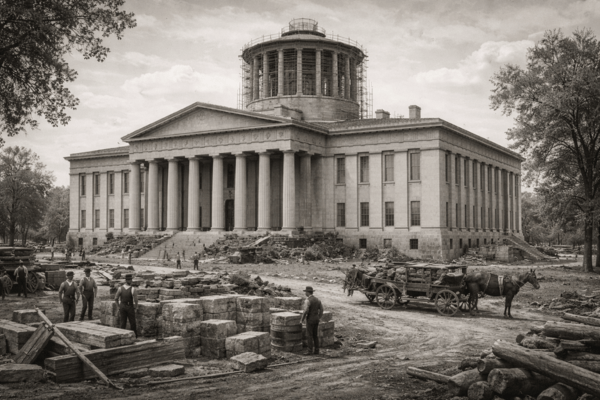
When construction finally concluded in 1861, the nation was tearing itself apart. The Statehouse opened its doors just as the Civil War began, its gleaming halls immediately thrust into the chaos of a country at war with itself.
Civil War Significance
Columbus became a critical hub for the Union war effort. Thousands upon thousands of soldiers passed through the city, many of them gathering near the newly completed Statehouse before marching south toward an uncertain fate. The building witnessed tearful goodbyes, patriotic speeches, and the quiet dread of young men who would never return home.
But the most profound moment came in April 1865. Abraham Lincoln had been assassinated, and his body was traveling home to Illinois on a funeral train that stopped in major cities along the way. Columbus was one of those stops. Lincoln’s coffin was brought to the Statehouse rotunda, where an estimated fifty thousand mourners filed past to pay their respects.
The grief was overwhelming. Witnesses described a city draped in black, the sound of weeping echoing through the marble halls. That collective anguish, that outpouring of sorrow from tens of thousands of souls, left an imprint that many believe has never faded.
The Dark History
The twenty two years of construction exacted a human toll that history has largely forgotten. Workers labored in dangerous conditions, hauling massive limestone blocks, working through brutal Ohio winters and sweltering summers. Accidents were common. Deaths, though not always recorded with precision, certainly occurred. Some workers simply disappeared from the records, their fates unknown.
Beyond the construction deaths, the land itself carries weight. Public executions took place nearby during the nineteenth century. Political rivalries turned violent. The emotional residue of war era grief, of mothers losing sons and wives losing husbands, of a president lying cold in the rotunda while a nation mourned, all of it seeped into the stone.
Decades of intense human emotion have embedded themselves in these walls. And walls, some say, have memories.
Reported Hauntings
The Phantom Soldiers
Security guards and late night staff have reported them for years. Apparitions in Union blue, moving through the corridors with military precision, their boots striking the marble in perfect cadence. Sometimes a single figure. Sometimes an entire company, marching in formation through the rotunda as if answering a call to duty that echoes across centuries.
The sounds come even when no figures appear. The rhythmic thud of boots. The distant rattle of drums. Muffled commands shouted by voices that belong to no living throat. These phantom soldiers seem trapped in an eternal muster, forever preparing for a war that ended over a hundred and fifty years ago.
The Lady in Gray
She appears most often in the basement, near the crypt area where shadows pool in corners untouched by modern lighting. A sorrowful female figure dressed in gray, her face obscured, her posture bent with grief. Witnesses describe an overwhelming sense of sadness in her presence, a weight that presses against the chest and brings unexpected tears.
Some believe she is connected to the Lincoln mourning period, perhaps a widow who came to pay respects and never truly left. Others speculate she lost someone during the war, her grief so profound it anchored her to this place where so many came to mourn. Whatever her origin, her appearances leave witnesses shaken, touched by a sorrow that does not belong to them.
Voices in the Senate Chamber
The Senate Chamber falls silent when the legislators leave. Or it should. Staff members working late have reported hearing voices rising in debate, passionate arguments echoing from the empty room. When they investigate, they find the chamber dark and deserted, the voices ceasing the moment the door opens.
Disembodied whispers have been recorded by paranormal investigators. Fragments of sentences. Names. The occasional sharp word of disagreement. Some believe former legislators continue their debates in death, unable to relinquish the power and passion that defined their living years. The issues they argue remain unknown, but the intensity is unmistakable.
The Wandering Workman
In the older sections of the building, where the original stonework shows its age and the modern renovations have not yet reached, a shadowy male figure has been spotted. He wears clothing that suggests the nineteenth century, and he moves with purpose through areas that were once construction zones.
He never acknowledges witnesses. He simply walks, his form sometimes solid enough to be mistaken for a living person, other times translucent and flickering. Many believe he is one of the workers who died during the endless construction, his spirit still laboring on a building he never saw completed. His appearances are brief, but they leave witnesses with a lingering chill that takes hours to shake.
Haunted Hotspots Within the Location
The Crypt and Lower Level
Originally designed to serve as a burial vault for Ohio governors, the crypt was never used for its intended purpose. Today it functions as a museum space, but visitors frequently report experiences that suggest the original design left some kind of mark. Cold spots appear without explanation, even on warm days. Shadow figures move at the edge of vision. The sensation of being watched is nearly universal.
Paranormal investigators consider this the epicenter of supernatural activity in the Statehouse. Equipment malfunctions are common. Photographs capture anomalies that cannot be explained by dust or camera glitches. Something resides in the lower level, something that was perhaps attracted by the building’s original intention to house the dead.
The Rotunda
This is where Lincoln lay. This is where fifty thousand people came to weep. The rotunda soars overhead, its dome allowing natural light to pour down into the circular space. It is beautiful. It is also deeply unsettling to those sensitive to atmosphere.
Visitors report sudden temperature drops that sweep through the space without any apparent cause. Some describe being overcome by waves of sadness so intense they must leave. Others have seen the faint outline of figures standing near where the catafalque once held the president’s body, mourners who have been gone for over a century but who remain, somehow, to pay their respects.
The Senate Chamber
Beyond the disembodied voices, the Senate Chamber has a reputation for causing electronic equipment to fail. Cameras die. Recording devices malfunction. Cell phones lose signal in areas where coverage should be strong. The pattern is too consistent to be coincidence.
Some researchers believe the residual energy of passionate debate has created an electromagnetic disturbance. Others believe something more conscious is at work, entities that do not wish to be documented or recorded. Either way, those who spend time alone in the chamber report a distinct feeling of not being alone.
Basement Corridors
The basement corridors stretch in long, dimly lit passages that seem to belong to a different era. The lighting is sparse. The silence is heavy. Footsteps echo strangely, sometimes returning when no one else is walking.
Visitors and staff alike have reported the distinct sound of footsteps following them through these corridors. When they stop, the footsteps stop. When they turn, no one is there. The Lady in Gray is most frequently spotted in these passages, her gray form appearing briefly before vanishing into the shadows. Those who encounter her rarely wish to return.
Visiting the Site Today
Access and Tours
The Ohio Statehouse welcomes visitors with free public tours that cover both the building’s rich history and, for those who ask, its supernatural reputation. Guides are often familiar with the ghost stories and willing to share accounts from their own experiences. Special evening events are occasionally offered, particularly around Halloween, providing access when the building takes on a more atmospheric character.
Those interested in the paranormal aspects should inquire about after hours programming or special themed tours. The staff has become accustomed to questions about hauntings and generally responds with openness and genuine interest.
Tips for Visitors
Arriving in late afternoon allows visitors to experience the transition from daylight to dusk, when shadows lengthen and the building’s character shifts. Photography during this time captures the structure at its most dramatic, with light and shadow playing across the limestone facade.
Visitors should remember that this remains a working government building. Respect is essential. The basement and crypt areas are must sees for those interested in paranormal activity, but discretion is advised. Listen more than speak. Observe more than demand. The spirits here, if they exist, seem to respond better to reverence than provocation.
Best Times for Atmosphere
Autumn evenings carry particular weight, especially around the anniversary of Lincoln’s funeral procession in late April. The energy of the building seems heightened during these periods, as if the structure itself remembers what occurred within its walls.
Quiet weekday afternoons, when crowds thin and silence settles over the corridors, offer the best opportunity for those seeking genuine experiences. The building feels different when empty. The echoes behave strangely. The shadows seem to move with intention. Those who visit during these quieter moments often come away changed.
Closing Scene
The security guard makes his final rounds, keys jangling against his hip as he moves through the empty corridors. The building has been cleared. Every office checked. Every door secured. He is alone.
Or he should be.
Behind him, footsteps echo against the marble. Measured. Deliberate. He stops. The footsteps stop. He turns, his flashlight beam cutting through the darkness, illuminating nothing but empty space and old stone walls. The silence presses in, thick and watchful.
He continues walking. The footsteps resume.
In the Ohio Statehouse, the past does not rest. It governs still.