
The fog rolls in low across the ground, curling between weathered Victorian monuments like phantom fingers reaching for the living. Somewhere in the darkness, gravel crunches beneath invisible footsteps. The sound stops. Starts again. Closer now.
Welcome to Old Gray Cemetery, one of Knoxville’s oldest and most atmospheric burial grounds, where thirteen acres of rolling hills hold the bones of a city’s forgotten past.
By day, this historic landmark draws history enthusiasts and genealogy researchers who wander its winding pathways beneath towering oaks. Families picnic near elaborate marble angels. Joggers pass through on their morning routes. The cemetery feels peaceful, even beautiful.
But as twilight descends and shadows stretch long across the weathered headstones, Old Gray reveals its other face. This is when the restless dead begin to stir. This is when visitors report hearing voices that belong to no one living, seeing figures that dissolve into mist, and feeling the unmistakable weight of unseen eyes following their every move.
Civil War soldiers still march here, trapped in an endless patrol. A grieving widow searches eternally for a grave she cannot find. And somewhere among the smallest headstones, a child weeps in the darkness, crying out for comfort that never comes. Paranormal investigators have returned to Old Gray Cemetery time and again, drawn by evidence they cannot explain and experiences they cannot forget.
Ready For More Ghost Hunts?
Check Out Our Ghost Tours of KnoxvilleHistorical Background
Founding and Purpose
In 1850, Knoxville’s citizens envisioned something revolutionary. Rather than the crowded, utilitarian churchyards that had served the growing city, they would create a garden cemetery, a place where death could be contemplated amid natural beauty and artistic monuments.
They named their creation after Thomas Gray’s famous poem “Elegy Written in a Country Churchyard,” a meditation on mortality that spoke to the Victorian fascination with death as a passage rather than an ending. The founders could not have known how prophetic that choice would become, how many souls would pass through these iron gates never to leave again.
Notable Burials and Historical Significance
Old Gray became the final resting place for those who built East Tennessee. Politicians and pioneers, merchants and ministers, they all found their way to these hallowed grounds. The cemetery holds the remains of Civil War soldiers from both Union and Confederate armies, enemies in life now lying side by side in death.
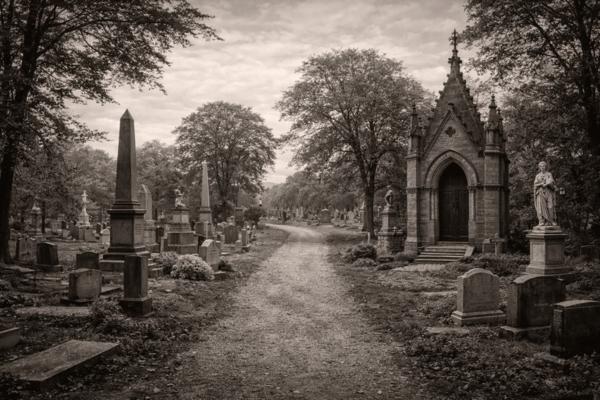
Elaborate monuments mark the graves of Knoxville’s elite, their wealth immortalized in marble and granite. Angels weep over the departed. Obelisks pierce the sky. Ornate iron fences enclose family plots where generations sleep together beneath the Tennessee earth.
The Dark History
But beauty cannot mask tragedy. When the Civil War came to Knoxville, it brought death on a scale the cemetery’s founders never anticipated. Soldiers died screaming from battlefield wounds, their blood soaking into soil far from home. Others succumbed more slowly to disease, their bodies wasted by typhoid and dysentery in overcrowded military hospitals.
The nineteenth century epidemics claimed more victims still. Cholera swept through the city, filling graves faster than headstones could be carved. Many of the dead were buried in unmarked plots, their identities lost to time, their spirits perhaps unable to rest without proper recognition.
The elaborate mourning statuary scattered throughout Old Gray tells its own sorrowful story. Weeping women draped over tombs. Broken columns symbolizing lives cut short. And in the children’s section, heartbreaking images of sleeping lambs and tiny angels, monuments to grief so profound it required stone to express.
Reported Hauntings
The Woman in White
She appears most often in the older Victorian section, a pale figure in flowing white garments that seem to glow faintly in the darkness. Witnesses describe her drifting between headstones, pausing at each one as if reading the inscriptions, searching for something she cannot find.
Local legend identifies her as a widow from the Civil War era, a woman who lost her husband to battle and spent her remaining years visiting the cemetery, desperate to locate his unmarked grave. Death brought her no peace. She continues her search even now, her mournful form appearing and disappearing like morning mist burning away in sunlight.
Those who have seen her speak of overwhelming sadness radiating from the apparition. Some have tried to approach, to offer comfort or simply satisfy their curiosity. But the Woman in White always vanishes before they can reach her, dissolving into the shadows as if she were never there at all.
Civil War Soldiers
The soldiers never left their posts. Near the Confederate and Union burial sections, visitors have reported ghostly figures in tattered uniforms standing at attention or wandering aimlessly between the graves. Their faces are gaunt, their eyes hollow, their movements slow and deliberate.
Even more disturbing are the sounds. After dark, when the cemetery falls silent and the city noise fades, some claim to hear the distant roll of drums. The rhythmic march of boots on packed earth. Anguished moans that seem to rise from the ground itself, as if the wounded were still crying out for help that never came.
These men died far from home, their final moments filled with pain and terror. Perhaps some part of them remains anchored to the place where their bodies were laid to rest, unable to move on from the trauma of their violent deaths.
The Weeping Child
No haunting at Old Gray Cemetery affects visitors more deeply than the specter of the weeping child. The small figure has been spotted near the infant and children’s graves, a wisp of white standing motionless among the tiny headstones.
But more often, the child is heard rather than seen. Soft crying drifts through the evening air, the heartbreaking sound of a young soul in distress. Visitors have searched desperately for the source, convinced that a living child must be lost somewhere in the cemetery. They find nothing. The crying continues, seemingly coming from everywhere and nowhere at once.
Those who experience this phenomenon leave shaken. Some report tears streaming down their own faces without understanding why, as if the grief of centuries has seeped into their bones.
Shadow Figures and Unexplained Phenomena
Beyond the identifiable spirits, Old Gray Cemetery hosts a darker presence. Shadow figures move between the monuments, shapes blacker than the surrounding darkness that slip from tombstone to tombstone. When approached, they vanish instantly, leaving behind nothing but the impression of having been watched.
Visitors frequently report cold spots throughout the grounds, sudden drops in temperature so dramatic that breath becomes visible even on warm summer nights. The sensation of being followed persists long after entering the gates. Equipment malfunctions are common, with cameras and phones draining batteries at inexplicable rates.
Something dwells within these thirteen acres. Something that has no intention of letting the living forget the dead.
Haunted Hotspots Within the Location
The Confederate Memorial Section
This solemn corner of the cemetery draws both historians and ghost hunters. The concentration of Civil War dead creates a powerful energy that many sensitives describe as turbulent and unresolved. Soldier apparitions appear here with startling regularity, and the sounds of residual battle, drums, shouted orders, the clash of distant combat, have been captured on audio recordings.
The Victorian Monument Row
Among the most elaborate nineteenth century graves, where marble angels spread their wings and ornate crosses reach toward heaven, the Woman in White makes her most frequent appearances. The monuments here seem designed to anchor the spirits of the departed, their intricate carvings creating a landscape that feels suspended between worlds.
The Children’s Burial Area
No location within Old Gray carries heavier emotional weight. The tiny graves, marked with lambs and cherubs and heartbreaking epitaphs, create an atmosphere of concentrated sorrow. Visitors entering this section describe being overwhelmed by sadness, feeling tears come unbidden, hearing the phantom crying that has no earthly source. Many cannot remain for more than a few minutes before the grief becomes unbearable.
The Iron Gates at Dusk
The transition begins at the entrance. Stepping through the ornate iron gates as evening approaches, visitors consistently report an immediate shift in atmosphere. The air grows heavier. A subtle disorientation takes hold, as if the world beyond the cemetery walls has receded into unreachable distance. Shadow movement at the periphery of vision becomes constant. Many who enter at dusk describe the unmistakable certainty that they are no longer alone.
Visiting the Site Today
Access and Hours
Old Gray Cemetery opens its gates to the public during daylight hours, closing promptly at sunset. The grounds welcome visitors seeking historical knowledge, genealogical research, or simply a peaceful place for contemplation. Self guided walking tours allow exploration at your own pace, while local preservation groups occasionally offer historical walking tours that delve into the stories behind the stones.
Tips for Respectful Visits
Those who visit Old Gray Cemetery walk on sacred ground. Remaining on established pathways protects both the graves and the fragile monuments that mark them. Disturbing any headstone, statue, or memorial dishonors the memory of those who rest here and may invite unwanted attention from protective spirits.
Photography is permitted, but those who approach their cameras with reverence rather than morbid curiosity often capture the most compelling images. Autumn visits, when fallen leaves carpet the ground and bare branches scratch against gray skies, enhance the cemetery’s inherent Gothic atmosphere. Overcast days cast the monuments in dramatic shadow, creating scenes that feel lifted from another century.
Best Times for Atmosphere
Late afternoon offers the most atmospheric experience for those seeking to feel Old Gray’s haunted presence. As shadows lengthen across the stones and the light takes on a golden, fading quality, the boundary between past and present seems to thin. Foggy mornings create an ethereal, otherworldly environment where monuments emerge from the mist like apparitions themselves.
Closing Scene
The last rays of sunlight retreat behind the tree line, surrendering the cemetery to blue twilight. Shadows pool between the monuments, spreading like dark water across the grass. The temperature drops, and the air takes on that particular stillness that precedes true darkness.
From somewhere deep within the grounds, a single crow calls out from an ancient oak, its harsh cry echoing off the stone. The iron gates creak as a groundskeeper pulls them closed, the metallic groan reverberating through the evening air.
But the closing of gates means nothing to those who dwell within. In Old Gray Cemetery, the dead may rest beneath their marble monuments and weathered headstones. They may lie silent through the daylight hours when tourists and historians walk above them. But when night falls and the living world retreats, they wake.
They always wake. Because in Old Gray Cemetery, the dead may rest, but they never truly sleep.