
The hour approaches midnight, and the brick streets of the Fort Worth Stockyards stretch out like veins of a sleeping beast. Somewhere in the darkness, a wooden fence creaks against its post, though no wind stirs the heavy Texas air. The scent of leather and dust hangs thick, a ghost of its own, impossible to wash away after more than a century of cattle drives and cowboy boots.
This is hallowed ground for anyone who knows the story of the American West. The Fort Worth Stockyards once stood as the pulsing heart of the cattle industry, a place where fortunes were made and lost before the sun could set. Millions of longhorns passed through these pens. Thousands of cowboys, traders, and dreamers walked these same streets, chasing something just beyond their reach.
But beneath the romanticized legend of the frontier lies something darker. Something that settled into the wooden beams and seeped into the red brick walls. Violence was common here. Death was constant. And for some, the final sunset never truly came.
Those who wander the Stockyards after dark often report the unmistakable feeling that they are not alone. The shuffling footsteps behind them belong to no one visible. The shadows move with purpose. And the whispers suggest that not everyone who passed through these grounds ever truly left.
Ready For More Ghost Hunts?
Check Out Our Ghost Tours of Fort WorthHistorical Background
The Rise of a Cattle Empire
The Fort Worth Stockyards emerged in the late 1800s as a sprawling marketplace for livestock, quickly becoming one of the largest such operations in the American Southwest. Situated at the crossroads of major cattle trails, Fort Worth earned its nickname as the place “where the West begins.”
Railroads cut through the Texas plains, bringing with them an endless stream of cattle destined for the meatpacking plants that sprouted alongside the pens. Cowboys drove herds for weeks across unforgiving terrain, and the Stockyards became their destination, their payday, and often their last stop before riding off into obscurity.
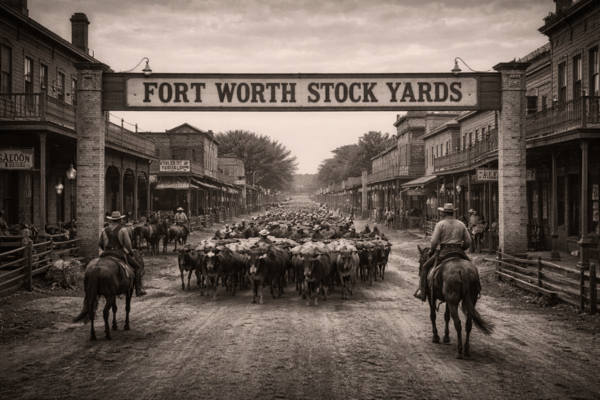
The district attracted more than just cattlemen. Outlaws drifted through, drawn by the chaos and opportunity. Gamblers set up shop in smoke-filled saloons. Traders haggled over prices while drifters searched for work, a meal, or trouble. The Stockyards became a microcosm of the frontier itself, lawless and alive with ambition.
The Dark Side of Progress
Progress in the Stockyards came at a brutal cost. The meatpacking plants operated with little regard for worker safety. Accidents were frequent and often fatal. Men fell into machinery. Others succumbed to disease in the unsanitary conditions. The work was relentless, the hours punishing, and the pay barely enough to survive.
Beyond the packing plants, violence erupted regularly in the saloons and boarding houses that lined the streets. Card games turned deadly. Disputes over money or women ended with gunfire. Bodies were sometimes left in alleys until morning, unremarkable casualties of frontier justice.
And then there were the animals themselves. Millions of cattle passed through these pens over the decades, their final moments filled with fear and confusion. Some believe that kind of collective anguish leaves a mark, an emotional residue that seeps into the very ground.
Poverty, disease, and sudden death were woven into the fabric of daily life here. For many, the Stockyards represented not opportunity but a dead end, a place where dreams came to die alongside the cattle. It is no wonder that so many restless spirits are said to linger.
Reported Hauntings
The Phantom Cowboy
He appears without warning on the empty streets after dark. A dusty figure in worn leather, his hat pulled low over his face. Witnesses describe seeing him walking with purpose, boots silent against the brick, before he dissolves into the shadows like smoke caught in a sudden breeze.
Those who have encountered the phantom cowboy say he never acknowledges their presence. He simply walks, endlessly, as if still driving a herd that no longer exists. Some believe he was a drover who died during a stampede, trampled beneath the hooves of his own cattle. Others suggest he met his end in a brawl, cut down in a fight over wages or a woman whose name has long been forgotten.
Whatever his story, he continues his lonely patrol, a relic of the Old West who refuses to ride into the sunset.
The Woman in White
Near the old stockyard exchange building, another figure has been spotted with unsettling regularity. She appears dressed in white, her gown flowing despite the stillness of the air. Her face is often obscured, turned away or hidden in shadow, but her presence radiates sorrow.
Speculation about her identity has spawned countless theories. Some say she was a widow who lost her husband to the violence of the district and never recovered from her grief. Others believe she worked in one of the nearby saloons, meeting a tragic end at the hands of a customer or a jealous rival.
She does not speak. She does not approach. She simply stands, watching, before fading from view. Those who have seen her describe an overwhelming sense of loss, as if her despair is contagious.
Disembodied Voices and Cattle Sounds
The streets of the Stockyards fall quiet after the tourists depart and the bars close their doors. But silence here is never absolute. Visitors who linger late into the night report hearing sounds that have no earthly source.
Phantom hoofbeats echo off the buildings, growing louder before abruptly stopping. The low, mournful sound of cattle lowing drifts through the air, though the pens have stood empty for decades. Men’s voices shout commands in the distance, driving invisible herds through the darkness.
These auditory hauntings seem to intensify in the latest hours, when the modern world sleeps and the old Stockyards remember what they once were. The sounds are residual, trapped in the fabric of the place, replaying moments that refuse to fade.
Restless Spirits of the Packing District
The areas where the meatpacking plants once operated carry a different kind of energy. Visitors report sudden cold spots that appear without explanation, dropping the temperature by several degrees in the span of a heartbeat. Shadowy figures move at the edge of vision, vanishing when confronted directly.
These spirits are believed to be the echoes of workers who died in the brutal conditions of the plants. Crushed by machinery, claimed by infection, or simply worked to death, they remain tied to the place where they drew their final breaths. Their presence is less dramatic than the phantom cowboy or the woman in white, but no less unsettling.
They linger in the margins, watching, waiting, perhaps unaware that their shift ended long ago.
Haunted Hotspots Within the Location
The Stockyards Hotel
This historic hotel has hosted guests for over a century, and not all of them appear to have checked out. Staff and visitors alike report unexplained footsteps pacing the hallways long after midnight. Doors swing open on their own, revealing empty rooms. Spectral figures have been glimpsed standing at the ends of corridors, disappearing when approached.
Certain rooms have developed reputations for heightened activity. Guests have reported the sensation of being watched while they sleep, objects moving without explanation, and the unmistakable feeling of someone sitting on the edge of the bed. The hotel embraces its haunted history, but spending a night within its walls remains an experience that tests even the skeptical.
The Cowtown Coliseum
Built in 1908, the Cowtown Coliseum has witnessed decades of rodeos, livestock shows, and rowdy crowds. The energy of those events seems to have accumulated within its walls. After the lights go dark and the spectators leave, strange sounds echo through the empty arena.
Workers cleaning up after events have reported seeing figures in the stands, sitting in seats that were empty moments before. Footsteps cross the arena floor when no one is present. Some have heard the distant roar of a crowd, cheering for a performance that ended generations ago.
The violence of the rodeo, combined with the sheer volume of human emotion that has filled this space, may explain why the Coliseum refuses to stay quiet.
Exchange Avenue
The main historic street of the Stockyards district becomes a different place after dark. The crowds vanish. The neon signs flicker. And the shadows between the buildings seem to deepen.
Those who walk Exchange Avenue at night often report seeing figures that should not be there. Shadowy silhouettes stand in doorways. Movement flickers in peripheral vision. The sensation of being watched is almost universal, a prickling at the back of the neck that refuses to subside.
This street has seen it all. Cattle drives. Gunfights. Desperate bargains and broken promises. The weight of that history presses down after sunset, and the past seems to bleed through into the present.
The Livestock Pens Area
The old pens stand largely empty now, preserved as a reminder of what once was. But visitors who venture near them after dark often report hearing sounds that defy explanation. The shuffle of hooves on packed earth. The low, distressed call of cattle. The crack of a whip.
A pervasive sense of unease settles over those who linger too long. Some describe it as grief. Others call it fear. Whatever the emotion, it seems to rise from the ground itself, residual energy from generations of cattle drives that ended in death.
The pens remember. And they make sure visitors remember too.
Visiting the Site Today
The Fort Worth Stockyards remain open to the public and continue to thrive as one of the most popular tourist destinations in Texas. By day, the district pulses with energy as visitors explore the shops, restaurants, and historic buildings that line the streets. The daily cattle drive down Exchange Avenue offers a glimpse into the past, a carefully preserved tradition that keeps the spirit of the Old West alive.
But for those seeking something darker, the Stockyards reveal their true nature after sunset. Ghost tours operate regularly, guiding participants through the most haunted locations while sharing the tragic histories that spawned the legends. These tours offer the best opportunity to experience the paranormal side of the district, combining historical context with spine-tingling exploration.
For the truly adventurous, a night at the Stockyards Hotel provides the chance to encounter the spirits firsthand. Request one of the rooms known for activity, keep the lights low, and wait. The hotel has earned its reputation, and many guests have checked out with stories they struggle to explain.
Respectful behavior is essential. This is not merely a haunted attraction but a place of genuine history and remembered tragedy. The spirits that linger here were once living people, and the ground beneath the streets absorbed more suffering than most places ever will. Approach with curiosity, but also with reverence.
Closing Scene
The mist rolls in from the Trinity River, curling through the empty streets like something alive. At the edge of the old cattle pens, a lone figure stands motionless, silhouetted against the amber glow of a distant streetlight. Whether visitor or specter, it is impossible to say.
Somewhere in the darkness, the faint echo of hoofbeats rises and falls, growing softer with each passing moment. The sound never fully disappears. It simply fades, retreating into the spaces between the buildings, waiting for the next quiet night to return.
In the Fort Worth Stockyards, the Old West never truly died. It just keeps riding through the dark, forever caught between the dust of what was and the silence of what remains.