
The final curtain has fallen. The applause has faded into memory. Now the Tennessee Theatre stands in that peculiar silence that only empty performance halls possess, a silence that somehow feels louder than sound itself.
Dim house lights cast amber pools across endless rows of velvet seats, their burgundy fabric stretching back into shadows that seem to breathe. The air carries traces of old perfume, dust from decades of footsteps, and something else. Something that lingers just beneath perception.
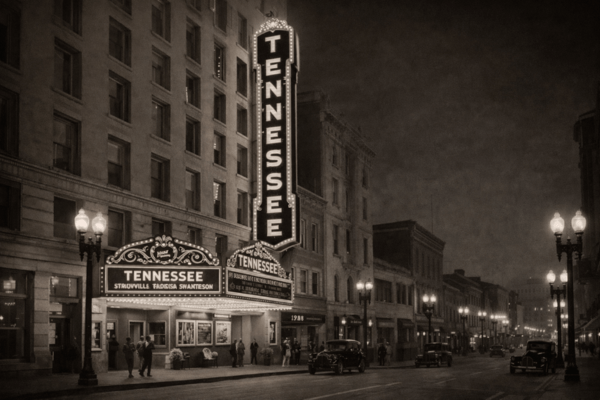
Rising like a fever dream from the heart of downtown Knoxville, the Tennessee Theatre has enchanted audiences since the roaring twenties. Its Spanish Moorish architecture drips with ornamental splendor, every carved detail whispering of an era when movie palaces were temples of escapism and wonder.
But this beloved landmark carries a dual reputation that extends beyond its architectural magnificence. Staff members speak in hushed tones about what happens after the crowds depart. Visitors report encounters that defy rational explanation. And somewhere in the upper reaches of the balcony, presences from another time seem eternally reluctant to leave their seats.
Ready For More Ghost Hunts?
Check Out Our Ghost Tours of KnoxvilleHistorical Background
The Tennessee Theatre opened its gilded doors on October 1, 1928, emerging into a world drunk on prosperity and possibility. Architects Graven and Mayger designed the palace in the Spanish Moorish style, creating an interior so lavish that opening night attendees reportedly gasped upon entering.
Every surface competed for attention. Ornate ceilings soared overhead, painted in rich jewel tones and accented with intricate plasterwork. A magnificent Wurlitzer organ rose from its pit to serenade audiences before each film. Grand chandeliers scattered light like captured stars across the faces of patrons who had paid their quarters to forget the outside world.
This was the dream of the roaring twenties made manifest. A cathedral of cinema where factory workers and socialites alike could sink into velvet seats and lose themselves in flickering silver screen fantasies.
But prosperity proved fleeting. The stock market crash of 1929 sent shockwaves through the nation, and suddenly the theatre’s opulent escapism took on a desperate edge. Throughout the Great Depression, audiences sought refuge within these walls, carrying their grief, their fear, their fading hopes through the lobby doors.
The decades that followed brought their own shadows. During wartime, young couples clutched hands in the darkness, some sharing their final moments together before departures from which there would be no return. Performers gave everything to their audiences, pouring their souls into songs and stories. Some breathed their last creative breaths on that very stage.
By the 1970s, the grand palace faced its own mortality. Demolition seemed inevitable. Only through passionate community effort was the Tennessee Theatre saved from the wrecking ball, restored and revived to serve new generations.
Yet restoration cannot erase emotional imprints. The walls have absorbed nearly a century of human experience. Joy and heartbreak. Celebration and mourning. And perhaps, some say, the souls who loved this place too deeply to ever truly leave.
Reported Hauntings
The Phantom Organist
The Wurlitzer organ sits in its pit like a sleeping giant, its pipes and keys silent during the late hours when cleaning crews make their rounds. Silent, that is, until it decides otherwise.
Staff members working after midnight have frozen in their tracks as music suddenly swells through the empty auditorium. Not mechanical sounds or random notes, but actual melodies. Songs from the 1930s and 1940s, played with the practiced hand of someone who knew this instrument intimately.
By the time anyone reaches the organ pit, the music stops. The keys rest motionless. The bench sits empty. Yet the air around the instrument feels charged, almost expectant, as though the unseen performer has merely paused between songs.
The Lady in White
She appears without warning and vanishes without explanation. A woman in vintage attire, her dress flowing in fabric that catches light from sources that no longer exist. Witnesses describe her as elegant, almost luminous, drifting through the mezzanine with the grace of someone who belonged to a more refined era.
Her path always follows the same trajectory. She emerges near the upper seating, glides along the curved walkway, and approaches the balcony stairs. Those who have glimpsed her say she moves with purpose, as though keeping an appointment that has outlasted her earthly existence.
At the top of the stairs, she simply ceases to be. One moment present, the next dissolved into shadow. Who she was in life remains unknown. What draws her back, night after night, year after year, remains unanswered.
Unexplained Voices and Laughter
Empty corridors should be silent. The Tennessee Theatre’s corridors rarely are.
Security guards patrolling after hours report disembodied whispers that seem to emanate from the walls themselves. Soft conversations in tones too faint to decipher, as though sounds from long ago performances have somehow embedded themselves in the building’s very structure.
More unsettling is the laughter. Delicate, genuine, the kind of amused response that follows a particularly clever joke or charming scene. It ripples through the darkness of the empty auditorium, suggesting that somewhere beyond perception, an invisible audience continues to enjoy entertainments that ended generations ago.
The Shadowy Stagehand
Backstage areas in any theatre carry their own particular atmosphere. Narrow passages, hanging ropes, equipment lurking in corners. But the Tennessee Theatre’s backstage holds something more than theatrical clutter.
Performers and crew members have reported a dark figure moving through the wings. Not a solid presence, but a shape darker than the surrounding shadows. It appears to perform tasks, adjusting equipment, checking ropes, attending to the countless duties that keep a theatre running.
Those who have glimpsed this figure believe it to be a former theatre worker, someone so dedicated to their craft that death itself could not convince them their shift had ended. The figure never acknowledges the living. It simply continues its eternal duties, a stagehand who never clocked out.
Haunted Hotspots Within the Location
The Balcony
The balcony draws paranormal activity like a magnet draws iron. Visitors ascending to the upper seats often report an immediate shift in atmosphere. The air grows heavy. Temperature drops by noticeable degrees. The feeling of being watched intensifies with each step upward.
Cold spots move through the balcony seating without pattern or predictability. One moment a particular row feels normal. The next, an icy pocket of air drifts past, raising goosebumps on exposed skin. Some visitors have captured fleeting shapes in photographs taken here, figures that were not visible to the naked eye.
Seats have been observed to fold down on their own, as though invisible patrons are settling in for a show that only they can see.
The Wurlitzer Organ Pit
Beyond the phantom music, the organ pit generates its own collection of inexplicable phenomena. The instrument’s mechanical components sometimes activate without human intervention. Keys depress. Pedals shift. The complex internal workings produce sounds that should require someone seated at the console.
Standing near the pit during quiet hours, visitors describe feeling vibrations through the floor. Not the rumble of traffic or building systems, but rhythmic pulses that match the tempo of music no living ear can hear. Some interpret this as residual energy from countless performances, forever echoing through the space.
Backstage and Dressing Rooms
The areas behind the curtain hold concentrated pockets of strangeness. Footsteps echo through corridors when no one else is present. Heavy doors swing open without assistance, revealing empty rooms beyond. The sensation of being followed persists even when backward glances confirm solitude.
Dressing rooms carry an oppressive weight that performers have learned to accept. Makeup mirrors reflect movement at the edges of vision. Personal items relocate themselves between uses. Some performers speak of feeling a presence standing behind them as they prepare for their entrances, a watcher who seems to evaluate their readiness for the stage.
The Grand Lobby
Even the grand lobby, with its sweeping staircase and ornate fixtures, provides no refuge from unexplained activity. Photographers reviewing their images have discovered orbs floating in shots that appeared completely normal through the viewfinder. Translucent spheres drift near the ceiling, cluster around the staircase, hover at the edges of doorways.
Temperature fluctuations strike without warning near the stairs. Guests have described walking through invisible curtains of cold air, brief passages through zones that feel degrees colder than their surroundings. The sensation passes quickly, leaving only the memory of that sudden chill and the question of what caused it.
Visiting the Site Today
The Tennessee Theatre remains gloriously alive, hosting concerts, classic film screenings, and special events throughout the year. Attending a performance offers the opportunity to experience this architectural treasure while surrounded by fellow enthusiasts, the auditorium filled with energy and light.
Historic theatre tours are occasionally available, providing access to areas normally closed to the public. These guided explorations reveal the building’s secrets, both architectural and otherwise. Knowledgeable guides share stories of the theatre’s past, including whispered accounts of its resident spirits.
For those seeking the most atmospheric experience, evening events offer the optimal opportunity. As natural light fades from the windows and artificial illumination takes over, the Tennessee Theatre transforms. Shadows deepen in corners. The ornate details take on different characters. The building reveals aspects of its personality that remain hidden during bright afternoon hours.
Late night events and off season tours provide the quietest moments, when crowds thin and the building settles into its nighttime stillness. These are the times when staff report the most activity. When the organ is most likely to play itself. When the lady in white makes her rounds.
Visitors should honor both the living history and the potential presences within these walls. The Tennessee Theatre has survived nearly a century through the dedication of those who love it. That respect should extend to whatever remains behind when the lights go down.
Closing Scene
The last guest passes through the lobby doors, footsteps fading into the Knoxville night. Behind them, staff members complete their final rounds, checking locks, dimming lights, whispering goodnights to empty corridors.
The grand chandelier flickers once, twice, then settles into darkness. Shadows reclaim the auditorium, pooling beneath seats and gathering in the wings of the stage. Somewhere in the walls, the old building exhales, settling into the deep quiet that follows performance.
High above the orchestra seating, in the darkness of the balcony, a single seat begins to move. Slowly, deliberately, the velvet cushion folds downward. It settles into position with a soft thud that echoes through the empty space.
No one sits there. No one visible, at least.
The Tennessee Theatre waits. It has been waiting for nearly a hundred years, and it shows no signs of growing impatient. In a palace built for performance, where dreams flickered to life on silver screens and music rose from gilded pipes, the question lingers in the perfumed air: who, or what, is still waiting for the curtain to rise?